🏗 Under Construction 🚧
This page is under construction and will present all the information we can find regarding this debate. There’s lots more info to come and we are excited to share it with you! In the meantime, we hope that what we have provided is enough to help you develope a well-informed opinion about this controversy. God bless!
Will the Lion lay down with the Lamb??
“The wolf also shall dwell with the lamb, and the leopard shall lie down with the kid; and the calf and the young lion and the fatling together; and a little child shall lead them.”
Isaiah 11:6
Remember that verse about the ‘lion shall lay down with the lamb?’ It’s not in the Bible anymore! The Bible has been supernaturally changed to say ‘wolf’ instead of ‘lion’ now!…Or has it?
Recently, a movement has arisen which claims Satan is using quantum mechanics to change all Bibles throughout time and space in an instant! The proof we are offered is that Isaiah 11:6 doesn’t say “lion” like everyone thinks it does. This is supposed to be a memory of the Bible before Satan changed it.
I know it sounds bizarre, but this is really what so many are claiming. Here’s an example if you still don’t believe it.
(Just messaged John Kirwin, an outspoken Mandela Effect proponent, to see if he has a short video explaining his position on Isaiah 11:6 and the Mandela Effect. Hang tight. 😁)
This theory not only poses a challenge to Bible-believing Christians, but also has some serious problems in its use of facts and logic. Deep diving into history and being aware of modern Bible translations causes the Mandela Effect to glitch and fade away. Let’s dive in!
Mandela Effect Playlists
We collect lots videos on this subject, and we’ve even made a few of our own! We don’t necessarily agree whole-heartedly with everyone who’s video we’ve added, but we hope you enjoy them anyway. 😉
Historical Documents Cry Wolf!
Historical documents also show that “wolf” is the historical reading of Isaiah 11:6. We have chosen a few examples that could be multiplied. These citations are labeled and organized as we have found them. Maybe you will find older ones. (See more documents from the 1600s, 1700s, 1800s.)
Challenge #1
For the record, EVERY version of the Bible in ANY language says and has always said “wolf.” Have you found any that don’t? Send it to us and we’ll include it on the page! Doctored images don’t qualify. 😉
Dead Sea Scroll “Isaiah 11 from Scroll 1Q Isaiaha“
“The Isaiah scroll, the oldest surviving manuscript of Isaiah: found among the Dead Sea Scrolls and dating from about 150 to 100 BCE, it contains almost the whole Book of Isaiah and is substantially identical with the modern Masoretic text.” – Book of Isaiah, Wikipedia
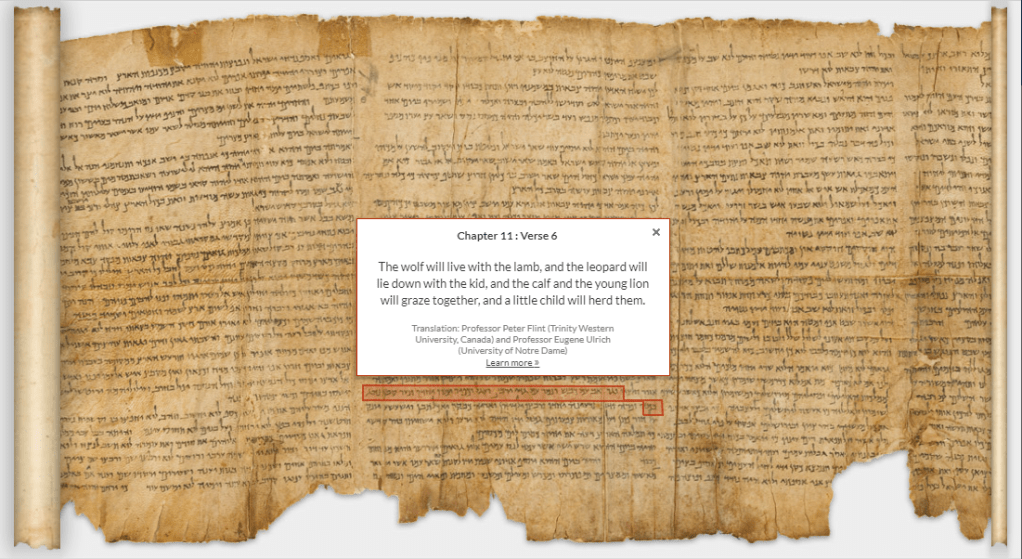
The oldest citation in any language:
“The wolf will live with the lamb, and the leopard will lie down with the kid, and the calf and the young lion will graze together, and a little child will herd them.” – dss.collections.imj.org.il
Septuagint (LXX)
The earliest citations in Greek:
“καὶ συμβοσκηθήσεται λύκος μετὰ ἀρνός καὶ πάρδαλις συναναπαύσεται ἐρίφῳ καὶ μοσχάριον καὶ ταῦρος καὶ λέων ἅμα βοσκηθήσονται καὶ παιδίον μικρὸν ἄξει αὐτούς” – blueletterbible.org
“and the wolf shall graze with the ram, and the sparrow shall rest with the heifer, and the calf, and the bull, and the lion;” Google Translate
John Chrysostom (AD 347-407)
Ancient Greek Christian commentary on Isaiah:
“Hear how the prophet foretold the diversity of this flock when he said, “Then a wolf shall feed with a lamb.”
Chrysostom. Demonstration Against The Pagans. 6.8. (see also – Chrysostom. Homilies On The Gospel Of Matthew. 10.3)
“The wolves and the lambs shall feed together; and the leopard shall lie with the kid, and lion shall eat straw like the ox.”
Chrysostom. Homilies Concerning The Statutes. 3.5. (neverthirsty.org)
Codex Sinaiticus (4-6th century)
“Καὶ συμβοσκηθήσεται λύκος [wolf] μετὰ ἀρνός, καὶ πάρδαλις συναναπαύσεταιἐρίφῳ, καὶ μοσχάριον καὶ ταῦρος καὶ λέων ἅμα βοσκηθήσονται, καὶ παιδίονμικρὸν ἄξει αὐτούς·” – Esaias 11 in Codex Sinaiticus
John Calvin 1509-1564
Verse 6
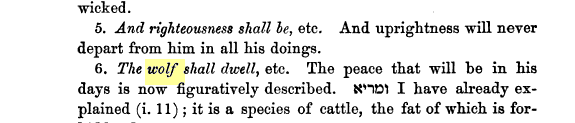
6.The wolf shall dwell with the lamb. He again returns to describe the character and habits of those who have submitted to Christ. As there is a mutual relation between the king and the people, he sometimes ascends from the body to the head, and sometimes descends from the head to the body; and we have already seen that Christ reigns, not for himself, but for those who believe in him.
Calvin’s Commentary on the Bible
The Messiah of the Christians and the Jewes by Sebastian Münster (1655), p. 183
Oldest citation in Modern English that we could find:
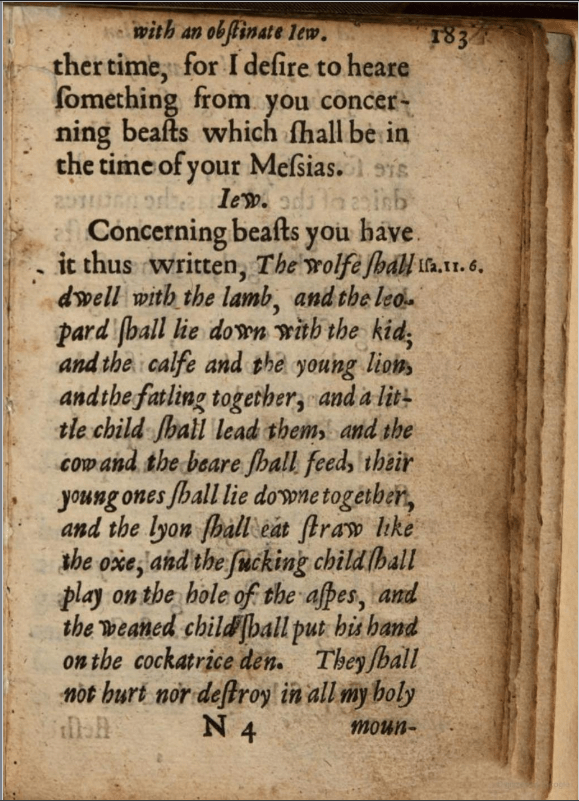
Campegius Vitringa (1659-1722)
See also Barnes’ Notes on the Whole Bible
Providence Gazette (1820)
Some quotations from the 19th century:
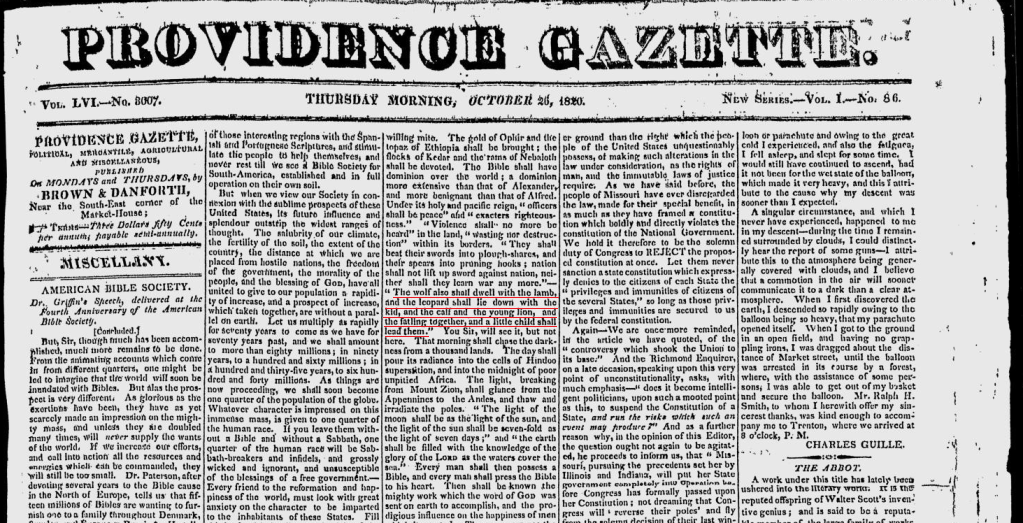
“The wolf also shall dwell with the lamb, and the leopard shall lie down with the kid, and the calf and the young lion, and the fatling together, and a little child shall lead them.” You Sir, will see it, but not here. That morning shall chase the darkness from a thousand lands. The day shall pour its radiance into the cells of Hindoo superstition, and into the midnight of poor unpitied Africa. The light, breaking from Mount Zion, shall glance from the Appennines to the Andes, and thaw and irradiate the poles.” – Dr. Griffin’s Speach delivered at the Fourth Anniversary of the American Bible Society (The Providence Gazette Oct 19, 1820)
The Works of John Owen (1854)
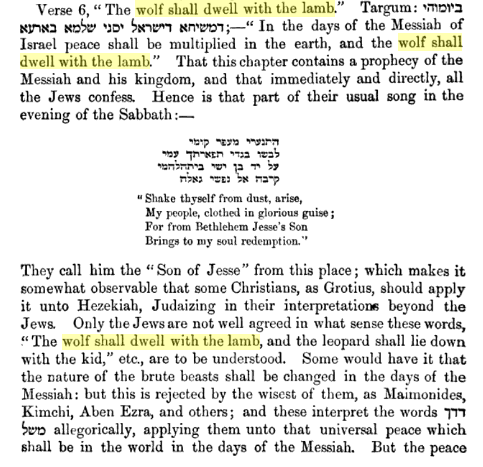
“Verse 6 ‘The wolf shall dwell with the lamb’ Targum: …דמשיחא דישראל יסגי שלמא בארעא In the days of the Messiah of Israel peace shall be multiplied in the earth and the wolf shall dwell with the lamb That this chapter contains a prophecy of the Messiah and his kingdom and that immediately and directly all the Jews confess Hence is that part of their usual song in the evening of the Sabbath התנערי מעפר קומי לבשו בגדי תפארתך עמי על יד בן ישי ביתהלהמי קרבה אל נפשי גאלה Shake thyself from dust arise My people clothed in glorious guise For from Bethlehem Jesse’s Son Brings to my soul redemption They call him the Son of Jesse from this place which makes it somewhat observable that some Christians as Grotius should apply it unto Hezekiah Judaizing in their interpretations beyond the Jews Only the Jews are not well agreed in what sense these words The wolf shall dwell with the lamb and the leopard shall lie down with the kid etc are to be understood Some would have it that the nature of the brute beasts shall be changed in the days of the Messiah but this is rejected by the wisest of them as Maimonides Kimchi Aben Ezra and others and these interpret the words (777…) allegorically applying them unto that universal peace which shall be in the world in the days of the Messiah.” – The Works of John Owen, D.D. John Owen BY THE REV. WILLIAM H. GOOLD (1854) (see p. 208 for references to Isaiah 11:6 mentioning the “wolf”.)
Barnes’ Notes on the Whole Bible (1853-1870)
The wolf also – In this, and the following verses, the prophet describes the effect of his reign in producing peace and tranquility on the earth. The description is highly poetical, and is one that is common in ancient writings in describing a golden age. The two leading ideas are those of “peace” and “security.” The figure is taken from the condition of animals of all descriptions living in a state of harmony, where those which are by nature defenseless, and which are usually made the prey of the strong, are suffered to live in security. By nature the wolf preys upon the lamb, and the leopard upon the kid, and the adder is venomous, and the bear, and the cow, and the lion, and the ox, cannot live together. But if a state of things should arise, where all this hostility would cease; where the wild animals would lay aside their ferocity, and where the feeble and the gentle would be safe;…
…
This description of a golden age is one that is common in Oriental writers, where the wild beasts are represented as growing tame; where serpents are harmless; and where all is plenty, peace, and happiness. Thus Jones, in his commentary on Asiatic poetry, quotes from an Arabic poet, “Ibn Onein,” p. 380:
Justitia, a qua mansuetus fit lupus fame astrictus,
Esuriens, licet hinnulum candidurn videat –
‘Justice, by which the ravening wolf, driven by hunger, becomes tame, although he sees a white kid.’ Thus, also, Ferdusi, a Persian poet:
Rerum Dominus, Mahmud, rex. potens,
Ad cujus aquam potum veniunt simul agnus et lupus –
‘Mahmud, mighty king, lord of events, to whose fountain the lamb and the wolf come to drink.’ Thus Virgil, Eclogue iv. 21:
Ipsae lactae domum referent distenta capellae
Ubera; nec magnos metuent armenta leones –
Home their full udders, goats, unurged shall bear,
Nor shall the herd the lordly lion fear.
And immediately after:
Occidet et serpens, et fallax herba veneni
Occidet –
The snake, and poison’s treacherous weed shall die.
Wrangham.
Again, Eclogue, v. 60:
Nec lupus insidias pecori, nec retia cervis
Ulla dolum mediantur: amat bonus otia Daphnis.
So also Horace, “Epod.” 16:53, 54:
Nec yespertinus circumgemit ursus ovile,
Nec intumescit alta viperis humus.
See also “Claudian,” Lib. ii. v. 25ff; and Theocritus, Idyl xxiv. 84, as quoted by Gesenius and Rosenmuller.
These passages are beautiful, and highly poetic; but they do not equal the beauty of the prophet.
…
That this passage is descriptive of the times of the Messiah, there can be no doubt. It has been a question, to what particular part of his reign the prophet has reference. Some have referred it to the time when he came, and to the influence of his gospel in mitigating the ferocity of his enemies, and ultimately disposing them to suffer Christens to live with them – the infuriated enemies of the cross, under the emblem of the wolf, the bear, the leopard, and the adder, becoming willing that the Christian, under the emblem of the lamb, and the kid, should live with them without molestation. This is the interpretation of Vitringa [“a Dutch Protestant theologian and Hebraist.” 1659-1722].
…
“Under the reign of the Messiah,” he saw that this would occur. Looking down distant times, as on a beautiful landscape, he perceived, under the mild reign of the Prince of peace, a state of things which would be well represented by the wolf dwelling with the lamb, the leopard crouching down with the kid, and a little child safe in their midst.
…
Under that gospel, the mad passions of men have been subdued; their wild ferocious nature has been changed; their love of conquest, and war, and blood taken away; and the change has been such as would be beautifully symbolized by the change of the disposition of the wolf and the leopard – suffering the innocent and the harmless to live with them in peace.
…
The fair interpretation of this passage is, therefore, that revolutions will be produced in the wild and evil passions of men – the only thing with which the gospel has to do as great “as if” a change were produced in, the animal creation, and the most ferocious and the most helpless should dwell together. The wolf (זאב ze‘êb) is a well-known animal, so called from his yellow or golden color. The Hebrew name is formed by changing the Hebrew letter ה (h) in the word זהב zâhâb, “gold,” to the Hebrew letter א – Bochart. The wolf, in the Scriptures, is described as ravenous, fierce, cruel; and is the emblem of that which is wild, ferocious, and savage among human beings; Genesis 49:27 : ‘Benjamin shall ravin as a wolf;’ Ezekiel 22:27 : ‘Her princes in the midst thereof are like wolves ravening the prey;’ Matthew 7:15 : ‘Beware of false prophets, which come to you in sheep’s clothing, but inwardly they are ravening wolves;’ John 10:12; Matthew 10:16; Luke 10:3; Acts 20:29. The wolf is described as sanguinary and bloody Ezekiel 22:27, and as taking its prey by night, and as therefore particularly an object of dread; Jeremiah 5:6 : ‘A wolf of the evenings shall spoil them; Habakkuk 1:8 : ‘Their horses are more fierce than the evening wolves;’ Zephaniah 3:3 : ‘Her judges are evening wolves, they gnaw not the bones until tomorrow.’ in the Scriptures, the wolf is constantly represented in contrast with the lamb; the one the emblem of ferocity, the other of gentleness and innocence; Matthew 10:16; Luke 10:3. The pagan poets also regard the wolf as an emblem of ferocity and cruelty:
Inde lupi cen
Raptores, atra in nebula quos improba ventris
Exegit caecos rabies, etc. –
(Virg. AEn. ii. 355ff.)
As hungry wolves, with raging appetite,
Scour through the fields, nor fear the stormy night –
Their whelps at home expect the promised food,
And long to temper their dry chaps in blood –
So rushed we forth at once.
Dryden.
Cervi, luporum praeda rapacium.
Hor. Car. Lib. iv. Ode iv. 50.
See a full illustration of the nature and habits of the wolf in Boehart, “Hieroz.” Part i. B. iii. ch. x. pp. 821-830. “Shall dwell.” גר ger. Shall sojourn, or abide. The word usually denotes a residence for a time only, away from home, not a permanent dwelling. The idea here is, that they shall remain peacefully together. The same image occurs in Isaiah 65:25, in another form: ‘The wolf and the lamb shall feed together.’
Barnes’ Notes on the Whole Bible
Henry Cowles (1869)
The wolf also shall dwell with the lamb, and the leopard shall lie down with the kid; and the calf and the young lion and the falling together: and a little child shall lead them.
…
The primary sense of these statements is very plain. — As the verb rendered “dwell” means, not to dwell in general but rather to sojourn as a guest, we must think of the lamb as taking the wolf into his fold as a friend, and making him at home in his own house. The calf, the young lion, and the fatling (the last named a specially tempting morsel or meal for a lion), shall lie down lovingly together.
…
They all contemplate a world full of depraved human nature, awaiting moral regeneration through the gospel. Therefore, these statements respecting the wolf and the lamb; the lion, the bear, and the asp; must legitimately refer to this same world and to the same depraved and mortal state in it.
…
The wolf in fraternal fellowship with the lamb is a symbol of the marvelous transformation wrought in persecutors and blasphemers when like Saul of Tarsus, “behold they pray!” and soon “preach the faith which once they destroyed.”
…
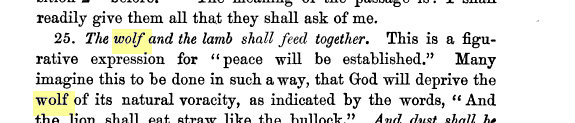
25. The wolf and the lamb shall feed together, and the lion shall eat straw like the bollock : and dust shall be the serpent’s meat. They shall not hurt nor destroy in all my holy mountain, saith the Lord.
Cowles, Henry – Isaiah: With Notes, Critical, Explanatory & Practical, Designed for Both Pastors & People, p. 93 (1869)
J.A. Alexander (1851)
“This abridgment of the larger work is by no means a small affair. For all ordinary purposes it is voluminous enough. We cannot too strongly recommend it.” – Spurgeon
This last is uniformly spoken of in Scripture as characteristic of Messiah’s reign, both internal and external, in society at large and in the hearts of his people. With respect to the latter, the prediction has been verified with more or less distinctness, in every case of true conversion. With respect to the former, its fulfilment is inchoate, but will one day be complete, when the lion and the lamb shall lie down together, and He who is the Prince of Peace shall have dominion from sea to sea, and from the river to the ends of the earth. An allusion to this promise and its final consummation may be found in the words of the heavenly host who celebrated the Saviour’s birth (Luke 2: 14), Glory to God in the highest, and on earth peace, good will to men. Fire is mentioned simply as a powerful consuming agent, to express the abolition of the implements of war, and, as a necessary consequence, of war itself.
…
Here, as in oh. 2:4 and 9: 5, 6, universal peace ia represented as a consequence of the Messiah’s reign, but under anew and striking figure. And the wolf shall dwell with the lamb, and the leopard shall lie down with the kid, and the calf and young lion and falling together, and a little child shall lead them. The third Hebrew noun includes the leopard and the panther, and perhaps the tiger. Calf denotes probably any fatted beast, and may here be mentioned because beasts of prey select such as their victims The wolf is introduced as the natural enemy of the lamb, and the leopard, as some allege, sustains the same relation to the kid. Dwell does not mean to dwell in general, but to sojourn as a stranger or a guest, and implies that the lamb should, as it were, receive the wolf into its home. The verb translated lie down is especially appropriated to express the lying down of sheep and other animals. Here it may denote that the leopard, accustomed to crouch while waiting for its prey, shall now lie down peaceably beside it; or there may be an allusion to the restlessness and fleetness of the wild beast, now to be succeeded by the quiet habits of the ruminating species. Most Christian writers, ancient and modern, explain the prophecy as wholly metaphorical, and descriptive of the peace to be enjoyed by God’s people under the new dispensation. Some apply the passage to the external peace between the church and the world, but it is commonly regarded as descriptive of the change wrought by Christianity in wicked men themselves. To give a specifft meaning to each figure in the landscape, making the lamb, the calf, and the fatted beast, denote successive stages in the Christian’s progress, the lion open enemies, the leopard more disguised ones, the wolf treacherous and malignant ones, the little child the ministry, not only mars the beauty but obscures the real meaning of the prophecy.
Alexander, J.A. – Isaiah: Translated & Explained, Abridged, (1851)
Notice when Joseph Alexander is referencing the concept of universal peace in passing he says “lion and lamb”, but when he get into the specifics of the passage he describes the wolf as dwelling with the lamb. He furthur criticizes those who try to read too much into the prophecy by making it an allagory of the Christian experience. This is solid evidence that the popular phrasing of “lion and lamb” has been in common use of centuries, but that the scriptures have remained unchanged. See also The prophecies of Isaiah translated and explained by Joseph Addision Alexander.
____ (1845)
6 The wolf also shall dwell with the lamb, and the leopard shall lie down with the kid;
…
These metaphorical expressions note, that everything shall contribute towards a firm and lasting peace, both inward and outward occasions of disturbances being removed ; the great and powerful, that use to oppress their inferiors, being disposed to come to terms of accommodation. This may be meant by the “wolf and the lamb’s dwelling together,” and the like expressions that follow (compare Ecclus. xiii. 17 — 19).
…
25 The wolf and the lamb shall feed together,
…
Ver. 25. The wolf and the lamb shall feed together, &c.] Concerning the metaphorical sense of these expressions, see the notes upon xi. 6, xxxv. 9. But since the renovation here spoken of extends to the whole creation (see Rom. viii. 21), they may imply the correcting the noxious qualities of fierce or venomous creatures.
…
Ver 17 What fellowship hath the wolf with the lamb? so the sinner with the ungodly.] The wise man having taken notice of the inconvenience and often danger of the poor keeping company with the rich, the weak with the powerful, the slavery of courts, and the proper carnage to be observed towards great men, he farther confirms his first thesis, that all persons ought to cultivate fellowship with those of the same rank and condition, by instancing in the godly and the sinner, who can much less than the other maintain friendship, and keep up an miimacy toocther, because their way of life, sentiments, inclinations, morals, and conduct, are disagreeable to each other, as dissonant as those of the wolf and the lamb: the one innocent, gentle, and amiable; the other, mischievous, outrageous, and devouring….The comparison of the wolf and the lamb, whose union is inconsistent in nature, is often made use of by Horace, and other writers, to show the impossibility of a iricndstiip improperly contracted. And when Isaiah, prophetically to show the blessed effects of the gospel, and the great change it should produce in men’s sentiments, uses the comparison of the wolf and the lamb dwelling and feeding together, he introduces that allusion to intimate, that the true religion should reconcile, and make one, those whom the vices of heathenism had so variously distracted and divided ; that persons, the most separated in interest, inclination, religion, and climate, should then happily unite, and compose one church (Isa. xi. 6).
A critical commentary and paraphrase on the Old and New Testament and the Apocrypha
by Patrick, Simon, 1626-1707; Lowth, William, 1660-1732; Lowman, Moses, 1680-1752; Arnald, Richard, 1700-1756; Whitby, Daniel, 1638-1726. Publication date: 1845
Notice how quotations of a passage are not infallibly precise from case to case? We cannot blame authors for this even when we see this less than computer-like accuracy among pastors and speakers today.
For many more commentaries on Isaiah 11, check out
William Day (ca. 1605-1684)
The Wolfe also shall dwell with the Lamb.] q. d. And because of Hezekiah‘s due and faithfull administration of justice, men shall dwell so peaceably together, that one shall not dare to offend or wrong the other.
The Wolf is a ravenous beast, which devour∣eth the Lamb, the lamb a gentle Creature and the usuall prey of the Wolfe: When therefore he saith, that the Wolfe shall dwell with the Lamb quietly, his meaning (by a Proverbe) is to shew, that those men, which were given to rapine and violence shall in Hezekiah‘s dayes, give over their lewd Courses, and betake themselves to an honest kind of life. This is that also which he mean∣eth by the Leopards lying down with the Kid; And the Calfes and young Lyons being toge∣ther, &c.
An exposition of the Book of the Prophet Isaiah by the endeavours of W. Day
Samuel White (1709)
“This author keeps to the literal sense and is very severe upon spiritualizers, of whose vagaries he gives some specimens. In aiming at one excellence he misses others, and fails to see Christ where he certainly is, thus rendering his remarks less valuable to the Christian mind.” – Spurgeon
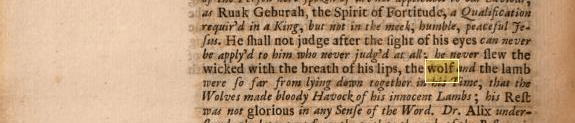
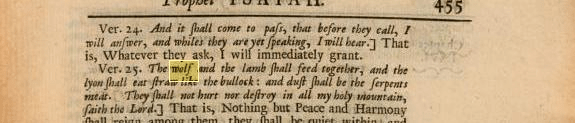
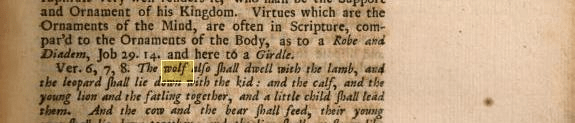
Note the following screen captures from Commentary on Isaiah, wherein the Literal Sense is Briefly Explained by Samuel White.
Robert MacCulloch (1791)
“In these days we need condensation. This author would have been far more valued if he had compressed his matter into one volume. He is good, but verbose. Some authors toil not, but they spin; Macculloch both toils and spins.” – Spurgeon
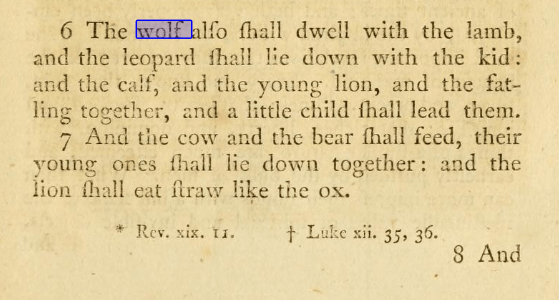
MacCulloch, Robert – Lectures on Isaiah, vol. 1 p. 665 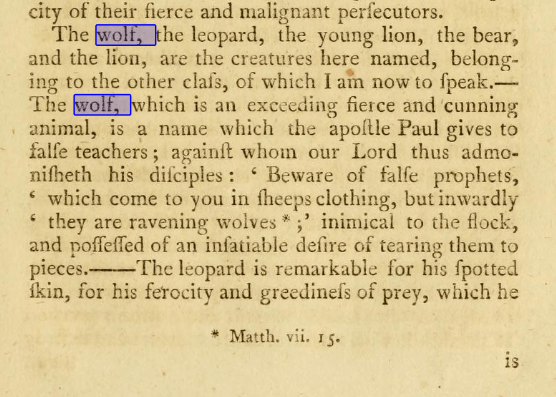
MacCulloch, Robert – Lectures on Isaiah, vol. 1 p. 669 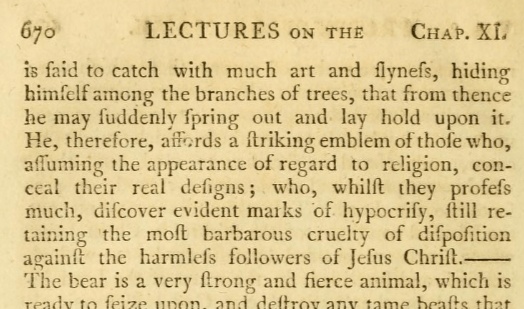
MacCulloch, Robert – Lectures on Isaiah, vol. 1 p. 670 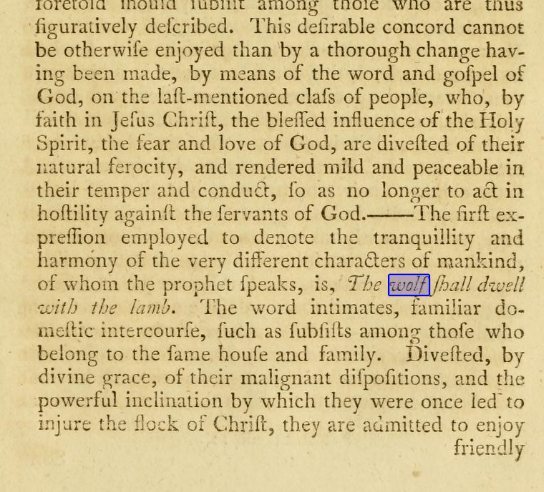
MacCulloch, Robert – Lectures on Isaiah, vol. 1 p. 671
Andrew Fuller (1845)
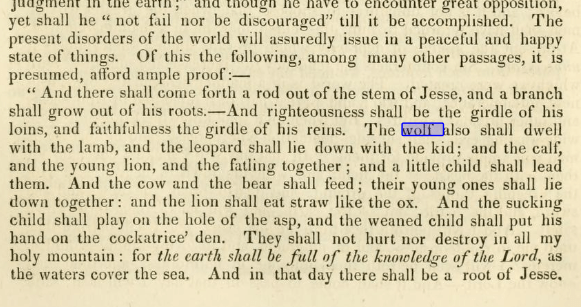
Thomas Rawson Birks (1887)

George Douglas (ca. 1895)
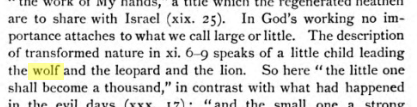
Robert Govett
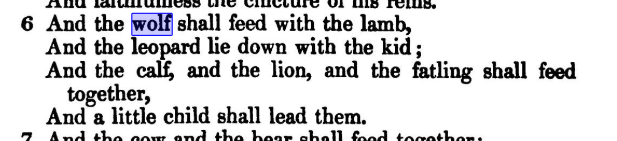
by
Robert Govett
Alfred Jenour (1830)
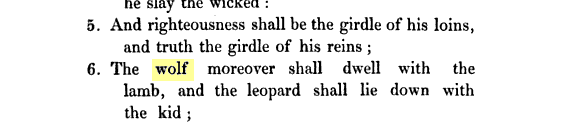
Alexander Keith (1850)
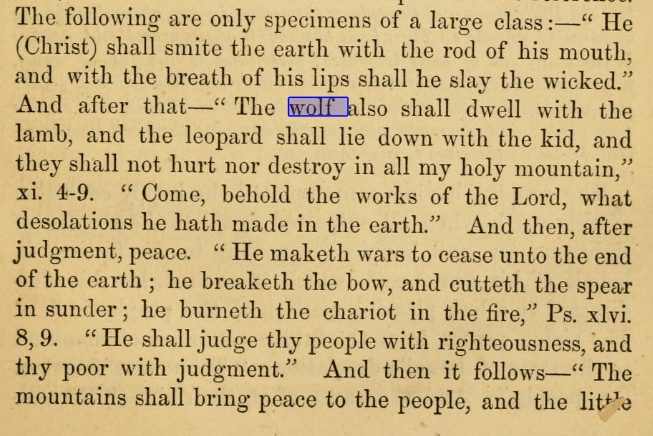
Robert Lowth (1836)
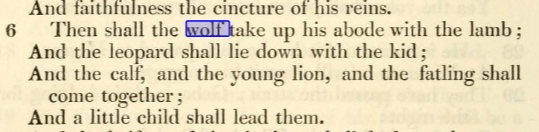
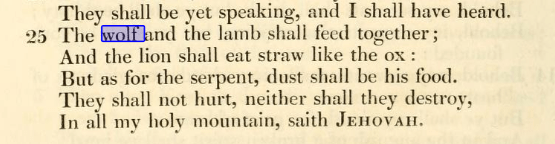
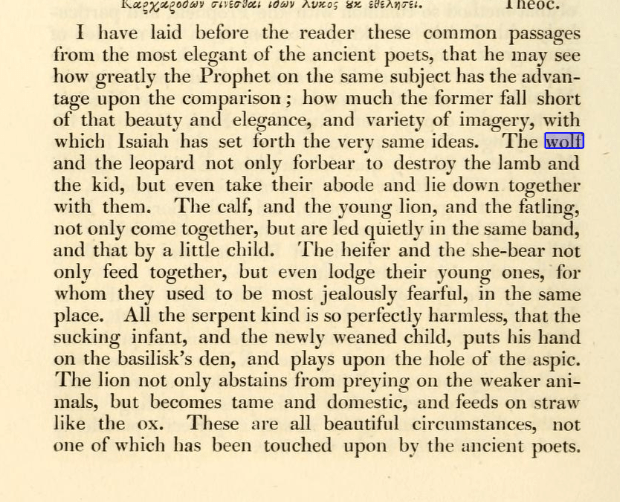
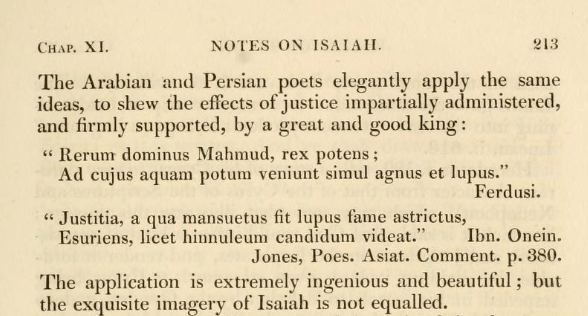
A literal translation of the Prophets from Isaiah to Malachi : with notes, critical, philological, and explanatory by Lowth, Robert, 1710-1787; Blayney, Benjamin, 1728-1801; Newcome, William, 1729-1800; Wintle, Thomas, 1737-1814; Horsley, Samuel, 1733-1806; Thomas Tegg & Son; R. Griffin and Co; Tegg, Wise, & Co; Massachusetts Bible Society
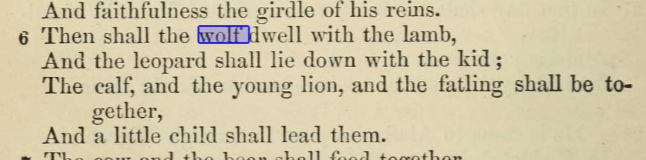
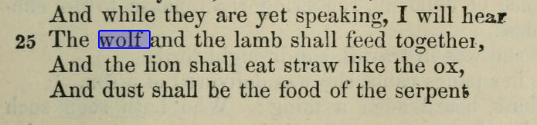
George Noyes (1849)
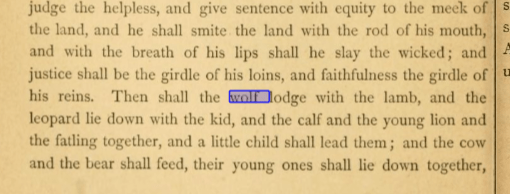
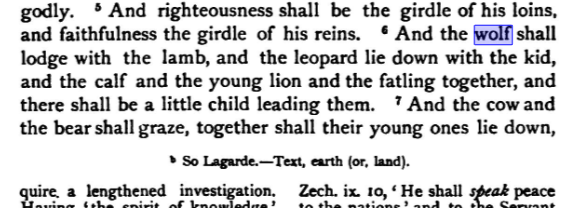
T.K. Cheyne (1880)
Franz Delitzsch (1894)
The fruit of righteousness is peace, which now reigns in humanity under the rule of the Prince of Peace, and even in the animal world, with nothing whatever to disturb it. “And the wolf dwells with the lamb, and the leopard lies down with the kid; and calf and lion and stalled ox together: a little boy drives them. And cow and bear go to the pasture; their young ones lie down together: and the lion eats shopped straw like the ox.…But when the Son of David enters upon the full possession of His royal inheritance, the peace of paradise will be renewed, and all that is true in the popular legends of the golden age be realized and confirmed. This is what the prophet depicts in such lovely colours. The wolf and lamb, those two hereditary foes, will be perfectly reconciled then. The leopard will let the teazing kid lie down beside it. The lion, between the calf and stalled ox, neither seizes upon its weaker neighbour, nor longs for the fatter one. Cow and bear graze together, whilst their young ones lie side beside in the pasture. The lion no longer thirsts for blood, but contents itself, like the ox, with chopped straw.
Delitzsch, Franz – Commentary on Isaiah
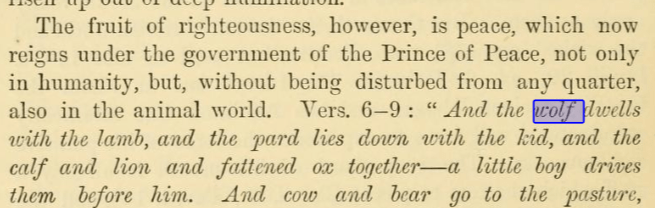
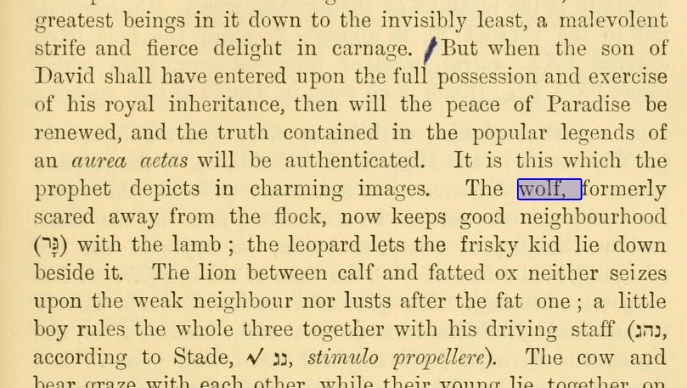
Conrad Orelli (1895)
This book is also know an “The prophecies of Isaiah / expounded by C. von Orelli ; translated by J.S. Banks”. “Hans Konrad von Orelli was a Swiss theologian.” (Wikipedia)
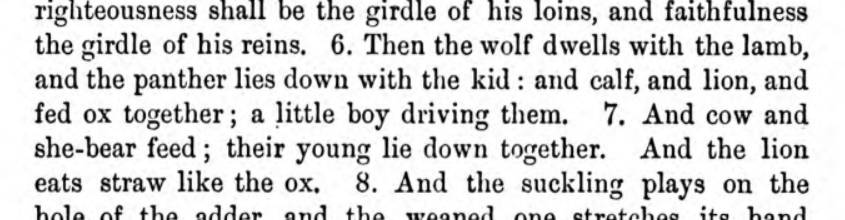
Ebenezer Henderson (1840)
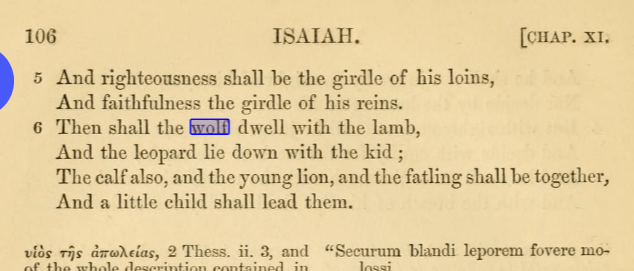
Abraham Ibn Ezra (1873)
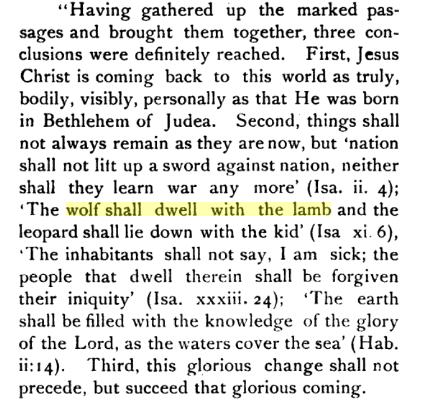
James H. Brookes: A Memoir (1897)
Historical Documents Say “Lion”…Sort of.
Below we have also included references to Isaiah 11:6 which mentions the “lion”. Does this demonstrate the loose sort of citation responsible for the popular misconception? What do you think? Tell us below. (See more citations from the 1700s, 1800s)
Oldest reference in any language to “lion”:
[We know of no ancient reference to Isaiah 11:6 which has “lion” rather than “wolf.” If you find one, please send it to us through the form at the bottom of this page.]
The Works of the Long-mournful and Sorely-distressed Isaac Penington by Isaac Penington (1681)
Oldest reference we could find in English to “lion”:

The New York Magazine (1796)
Another old English reference to “lion”:

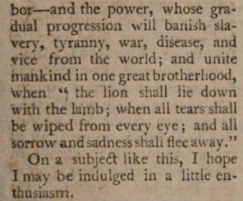
Essay on Good Nature. [Read in the Franklinian Society (Philidelphia), March 16, 1791]. THE NEW YORK MAGAZINE; OR, LITERARY REPOSITORY 1796. NEW SERIES – VOL. I. (p. 405)
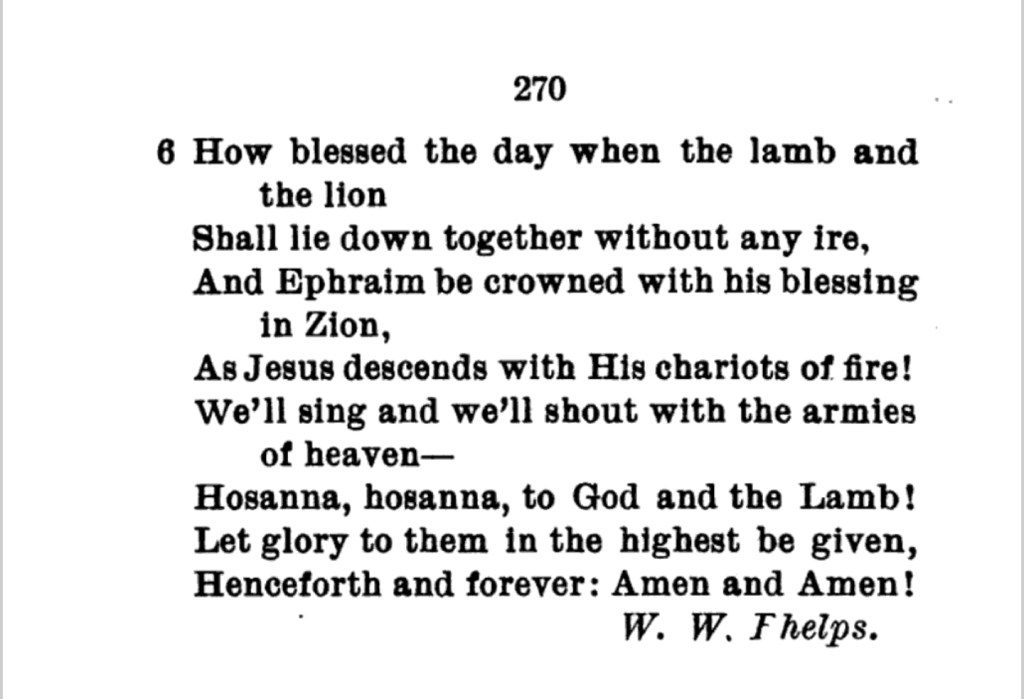
Mormon Hymn Book (1899)
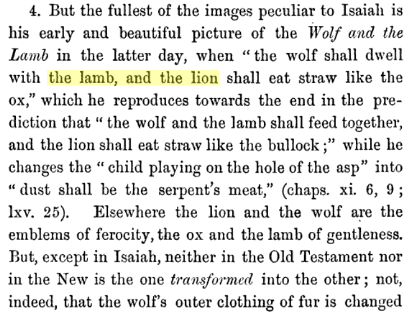
The Bible True to Itself (1884)
Good reading for Mandelits who emphasize the wolf’s diabolical symbolism.
The Great Texts of the Bible (1910)
Old reference the wolf and lamb and to Jesus Christ, the Lion and Lamb in the same book:
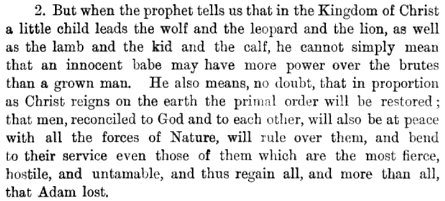
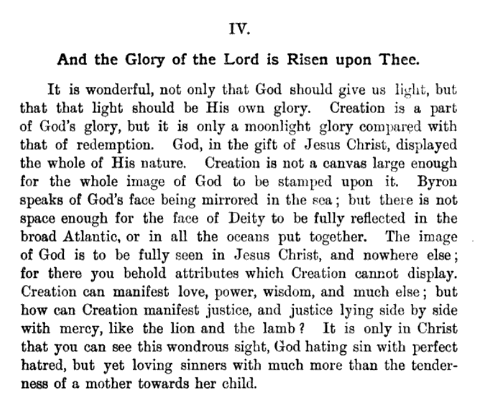
The Great Texts of the Bible edited by James Hastings (p. 140, 441)
J Vernon McGee (19__)
Dr. McGee reads the Bible on front of him. It says “wolf” not “lion”. Then he proceeds to say that is the day when the lion and lamb shall lie down together and the lion will eat straw. This demonstrates how firmly entrenched the popular “lion and lamb” imagry is entrenched in our society.
A Dictionary of Biblical Tradition in English Literature (1992)
Recently published Bible dictionary – now this is interesting.
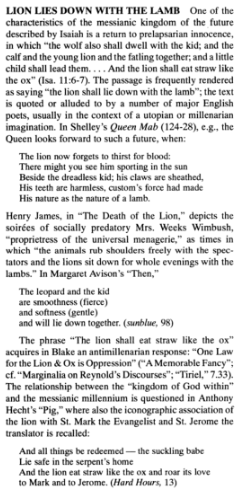
A Dictionary of Biblical Tradition in English Literature by David Lyle Jeffrey (1992) (p. 456)
Johanna Manley (1995)
Manley, a Catholic author, preserves the teachings of ancient Christians regarding Isaiah. Although we believe Catholicism is wrong and dangerous, his writings show that it is possible to reach back into the early centuries and discover the meaning and wording which has endured the ages regardless of modernism and Nelson Mandela. You may well find his work on Isaiah Through the Ages fascinating.
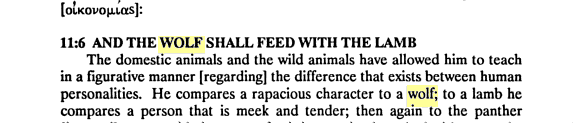

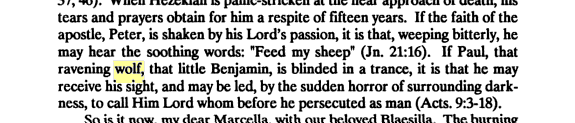
Steven McKinion (2005)
Christopher R Seitz (1993)
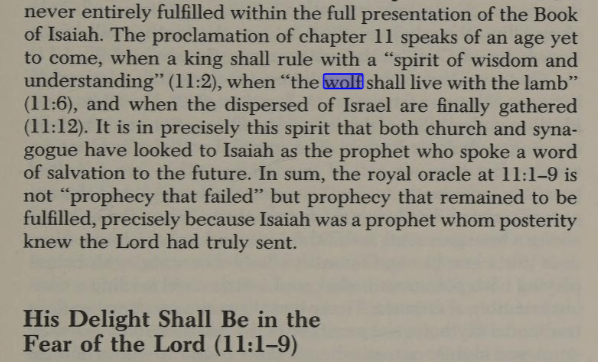
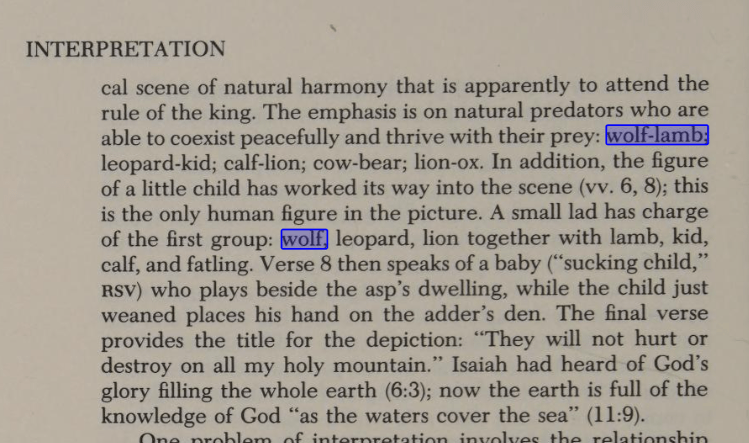
Robert L. Wilken (2007)
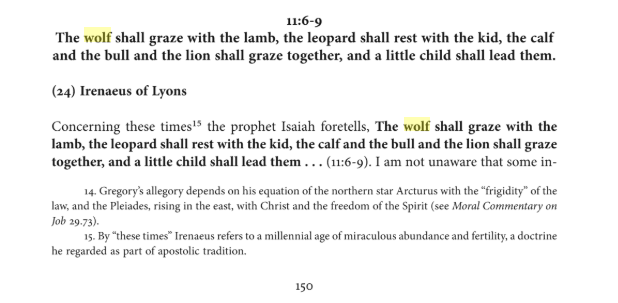
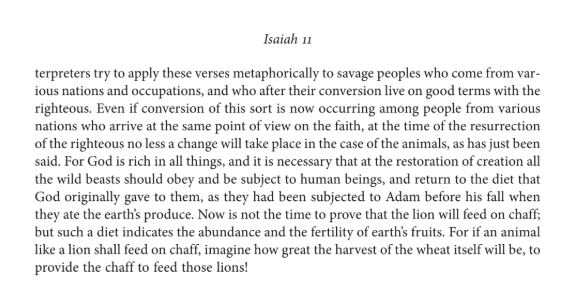
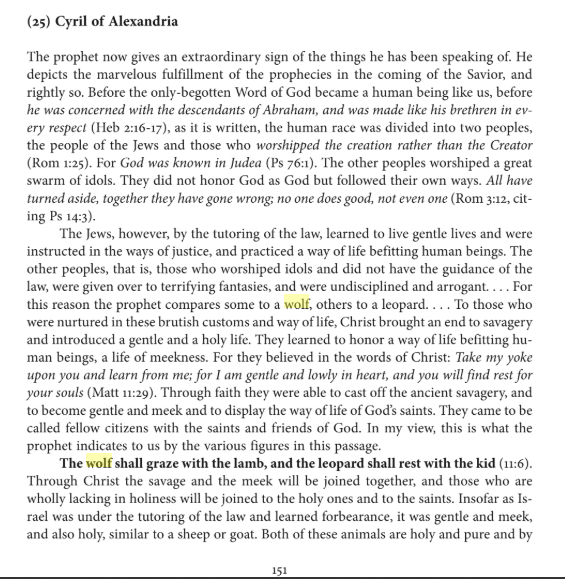
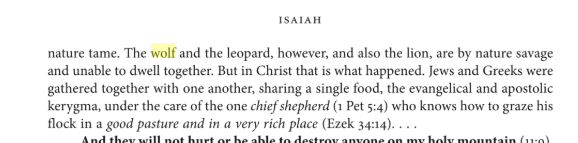
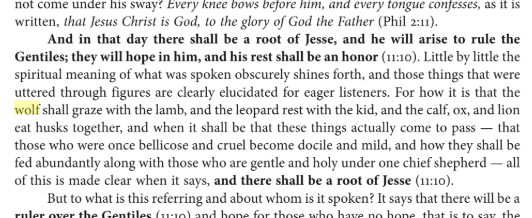
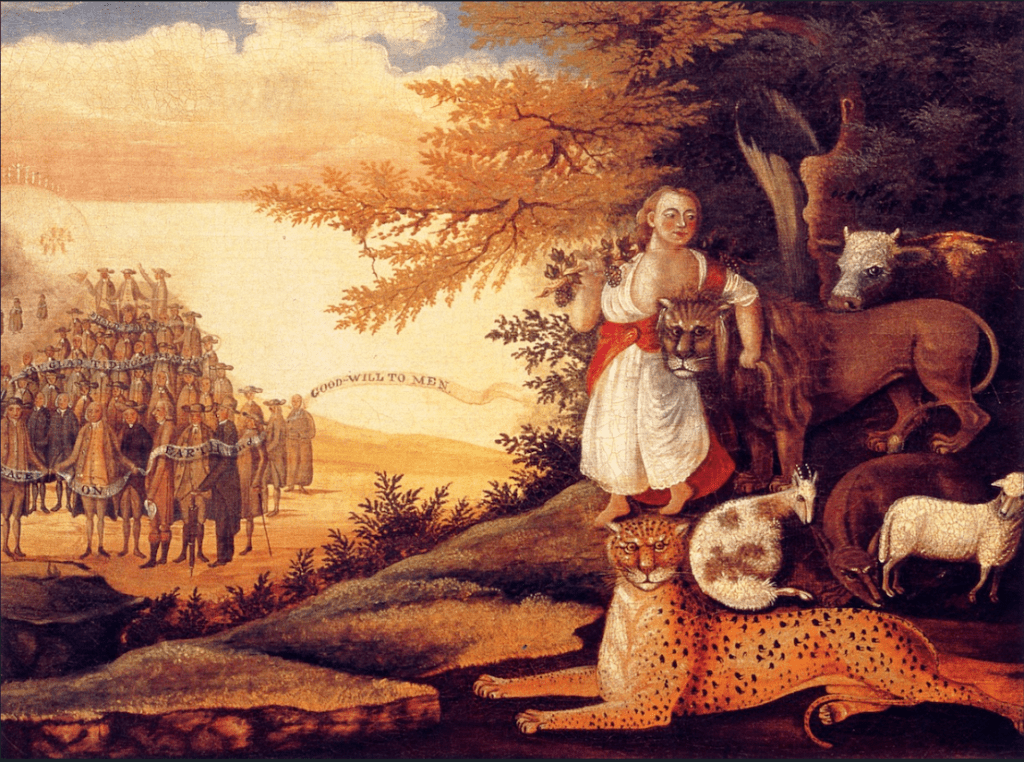
Art Cries Wolf!
Unaltered images of historical art soundly refute the Mandela Effect. We are happy to provide the images below to further the research of those engaging in this debate.
The Mandelite claim is that the wolf in Isaiah 11:6 used to be a lion before the KJV was supernaturally changed by CERN, D-Wave computers, time travel, black magic, or something else equally exotic. We are told to believe that all evidence to the contrary is “residue” which was to be expected because CERN and Satan are pretty sloppy. Does this claims hold up? You decide that.
Note: Click on any of the images below to view them closeup in slideshow mode. If you want to do further research on any of this art, we recommend using Google Lens to find these and similar pieces.
The serious question must be asked, if lion and lamb christian t-shirts are “residue”, why is there no residue at all among any witness of the passage in any age?
Ultimately, no amount of research or reason can breach the walls of a heart hardened with pride and a mind self-deceived. Rather than a mere change of mind, there needs to be a change of heart which only God’s grace can provide. It is our prayer that our less-than-perfect memories and heart may be willing to be corrected in the light of God’s word and the facts.
The Quakers Strike Back!
Wait! Aren’t Quakers pacifist? Yes, but today the Quakers are on the march and their armed with more than oat meal! One massive stands tall above his companions at the fron of the army. Our hero carries loaded paintbrushes and a glistening pallet knife. Soon the battlefield will be wet with oil paint drawn from the veins of Mandela Effect YouTubers! …But seriously, this Quaker is awesome.
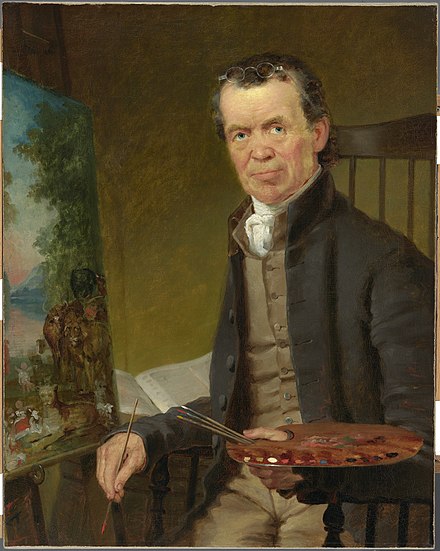
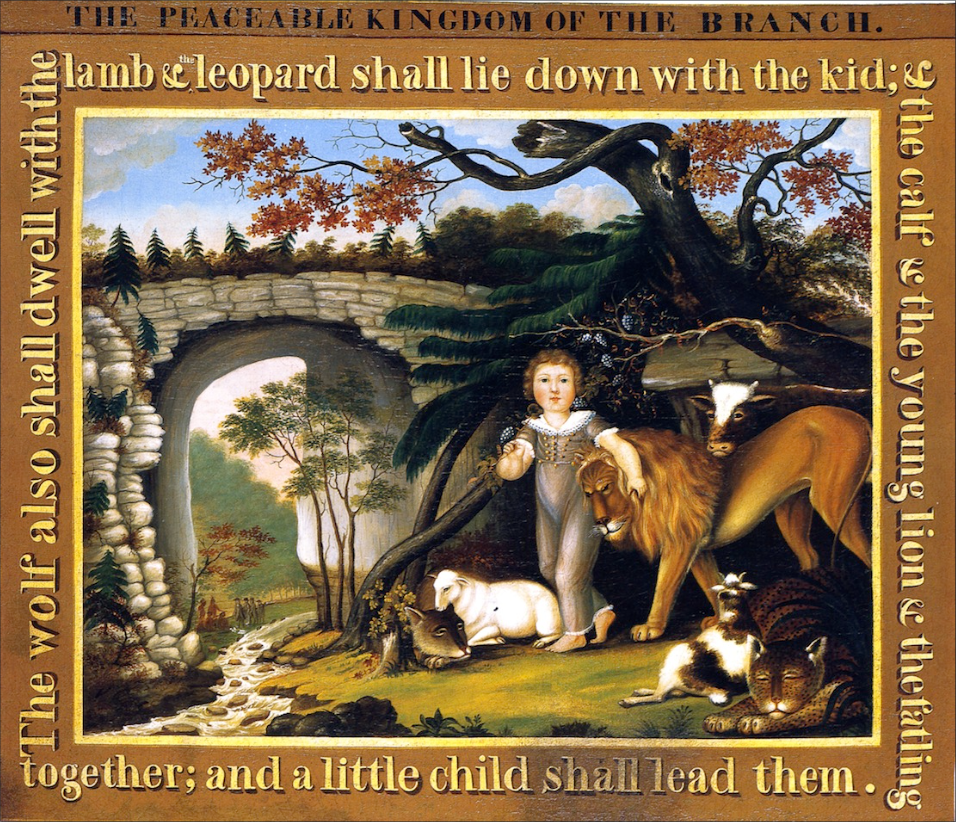
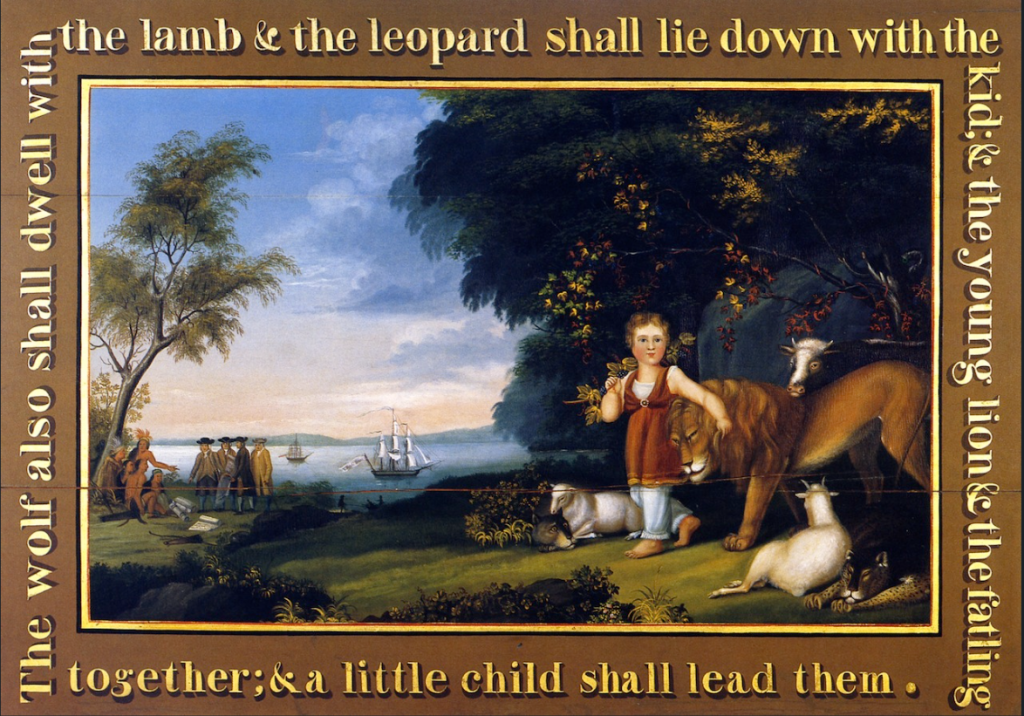
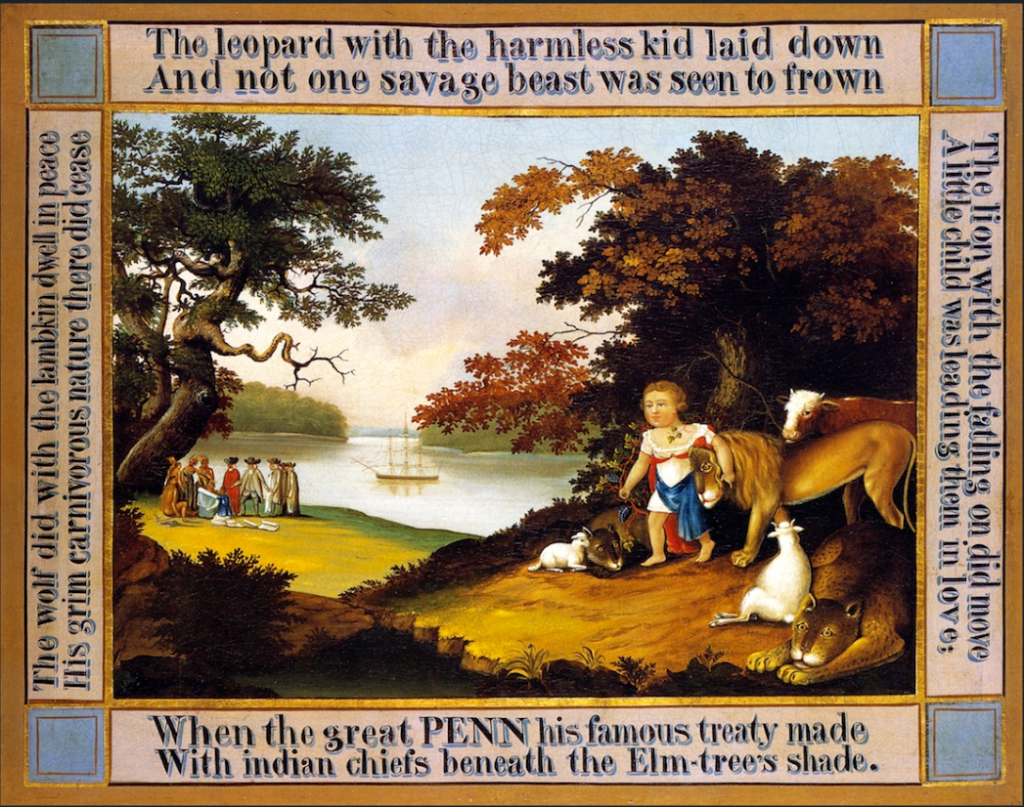
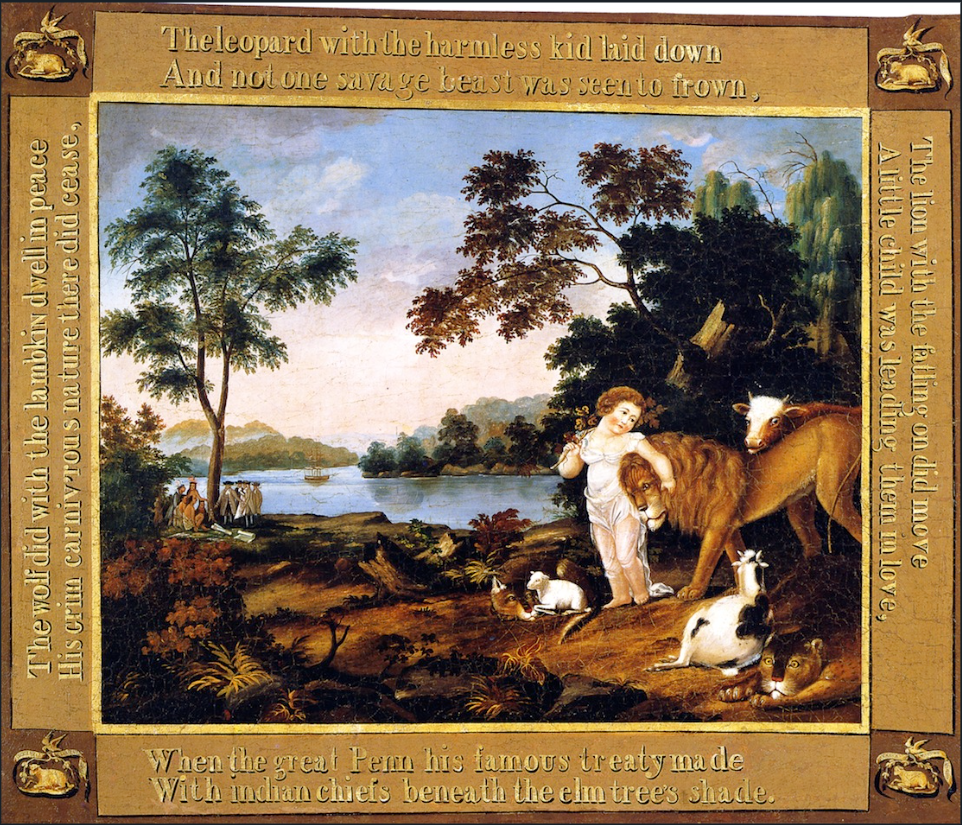
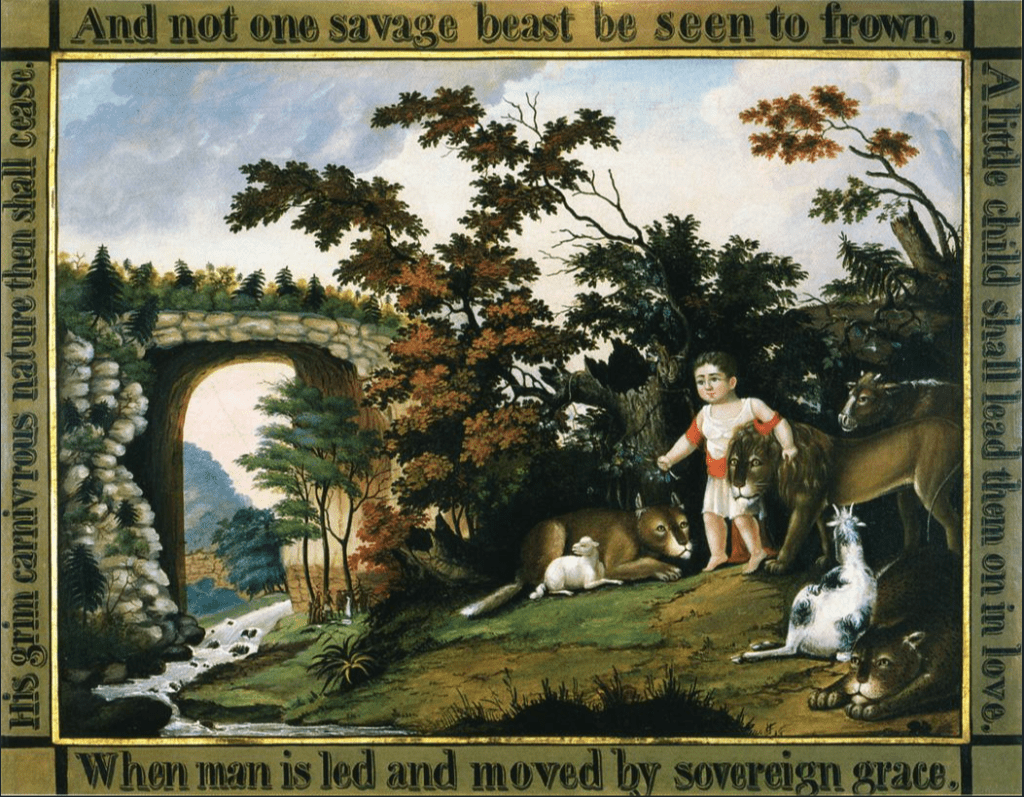
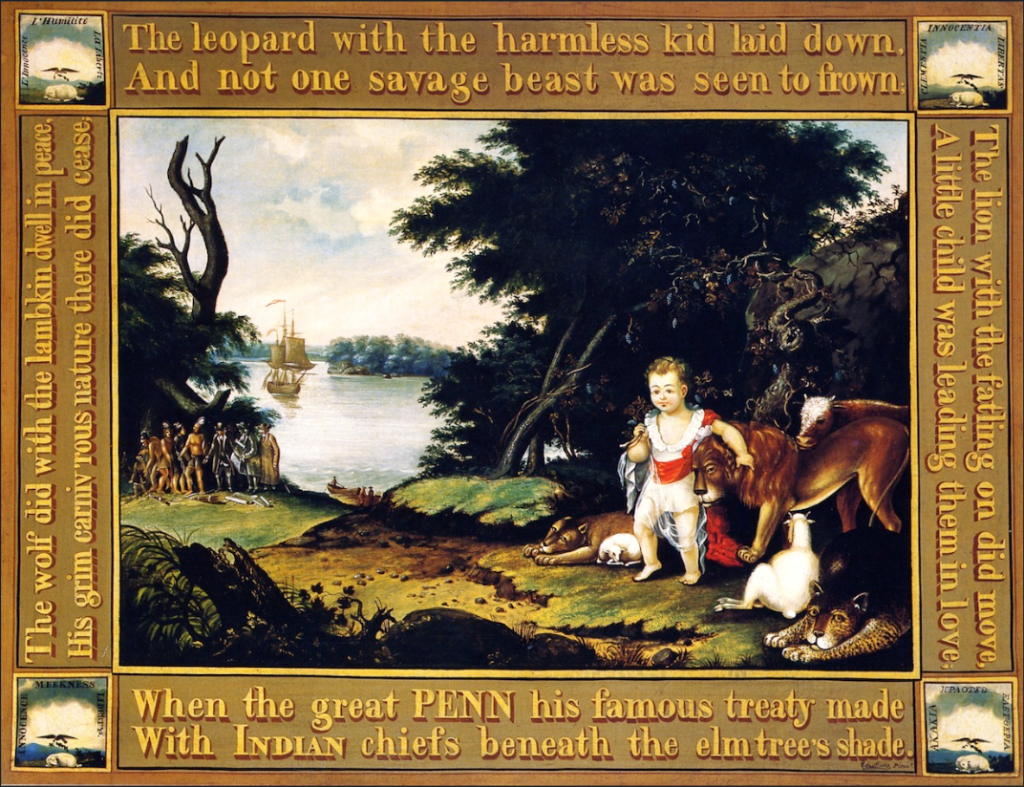
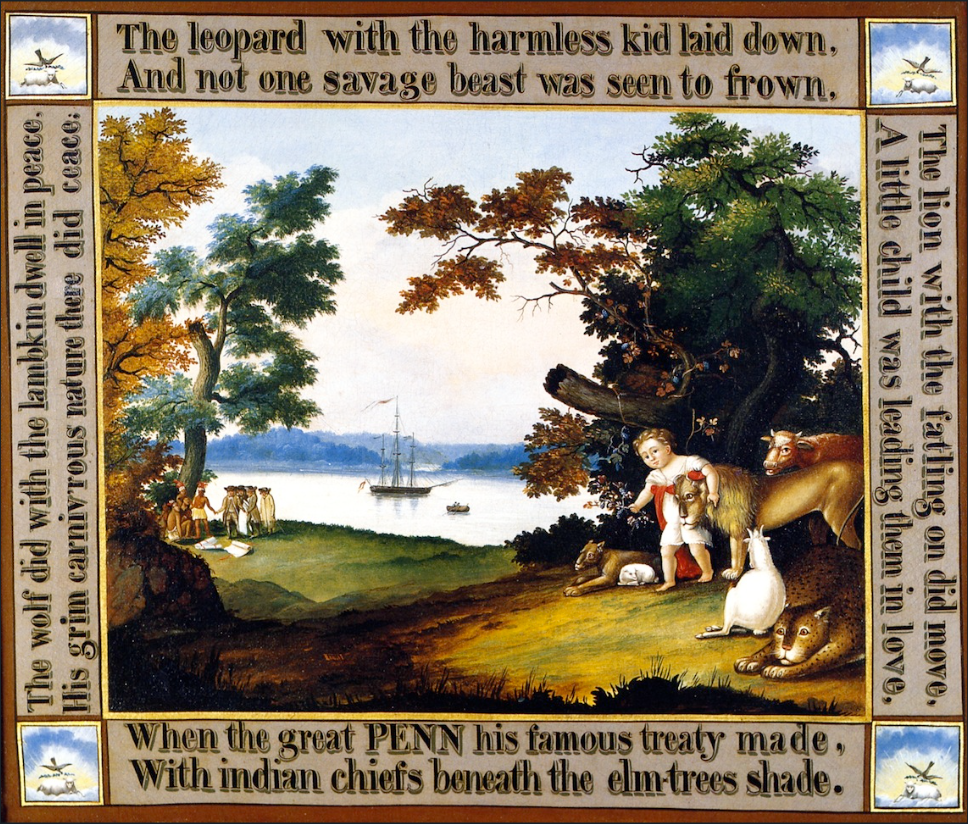
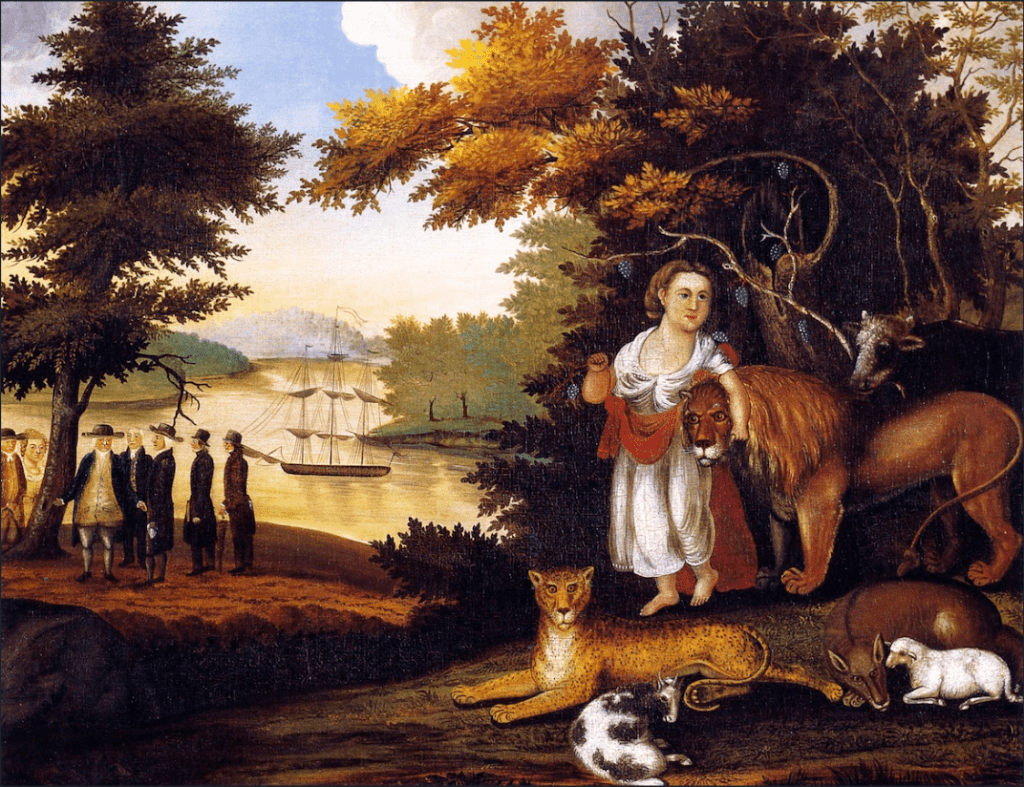
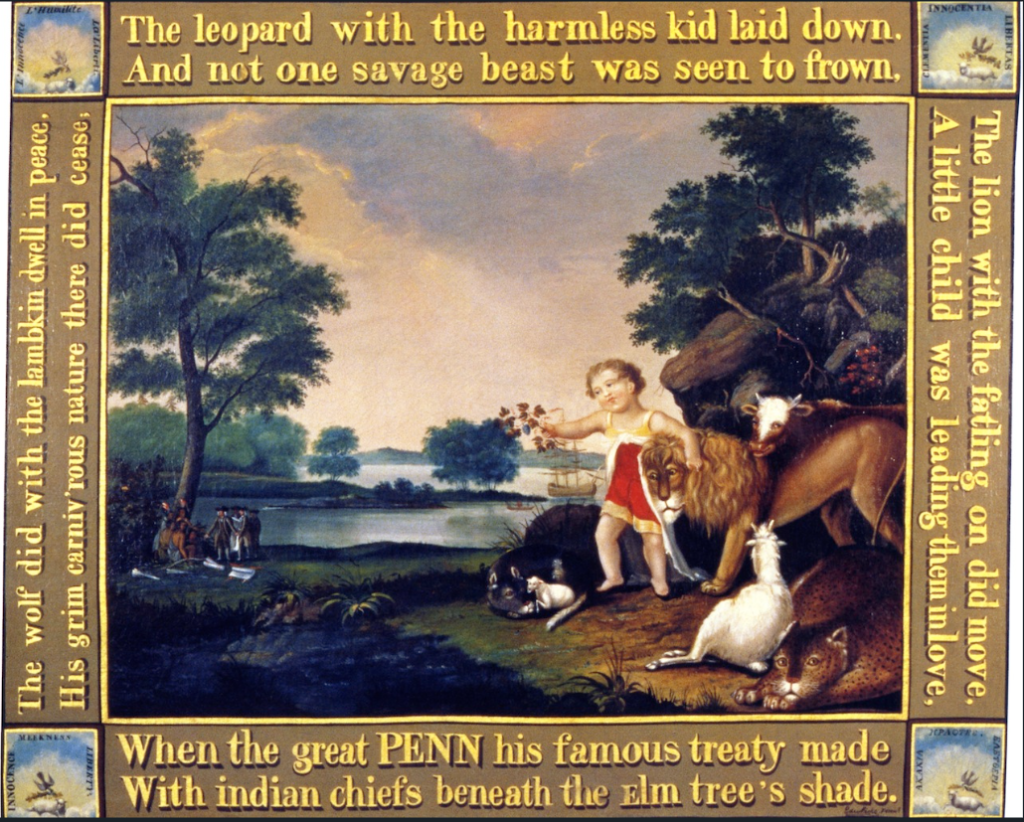
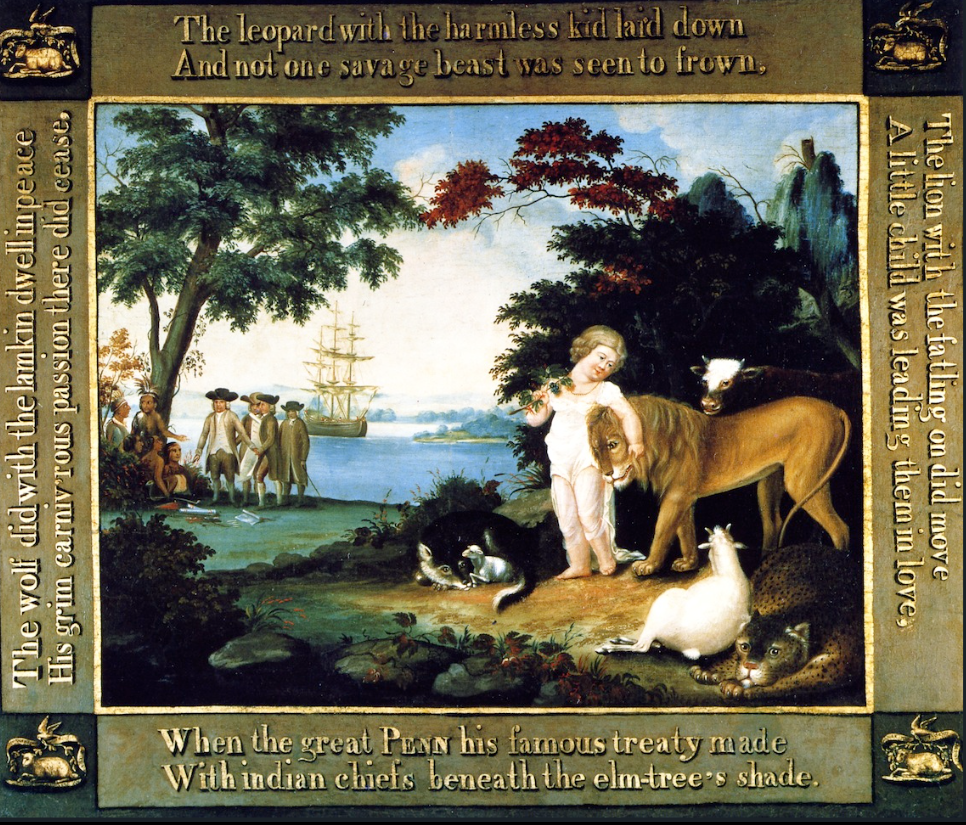
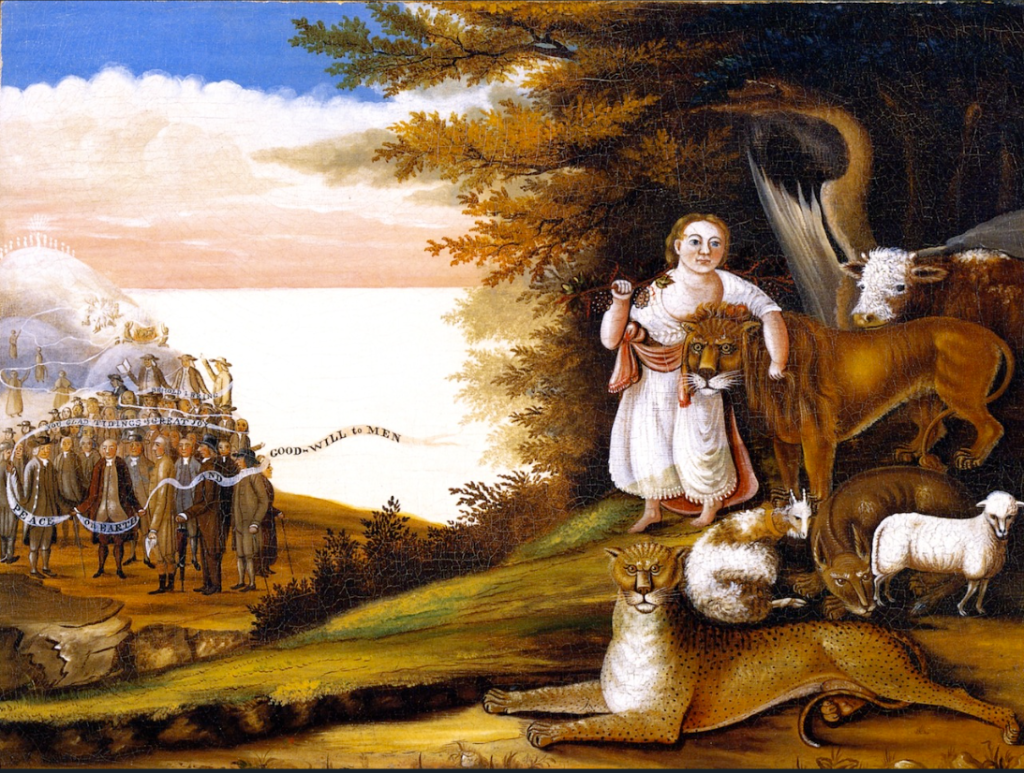
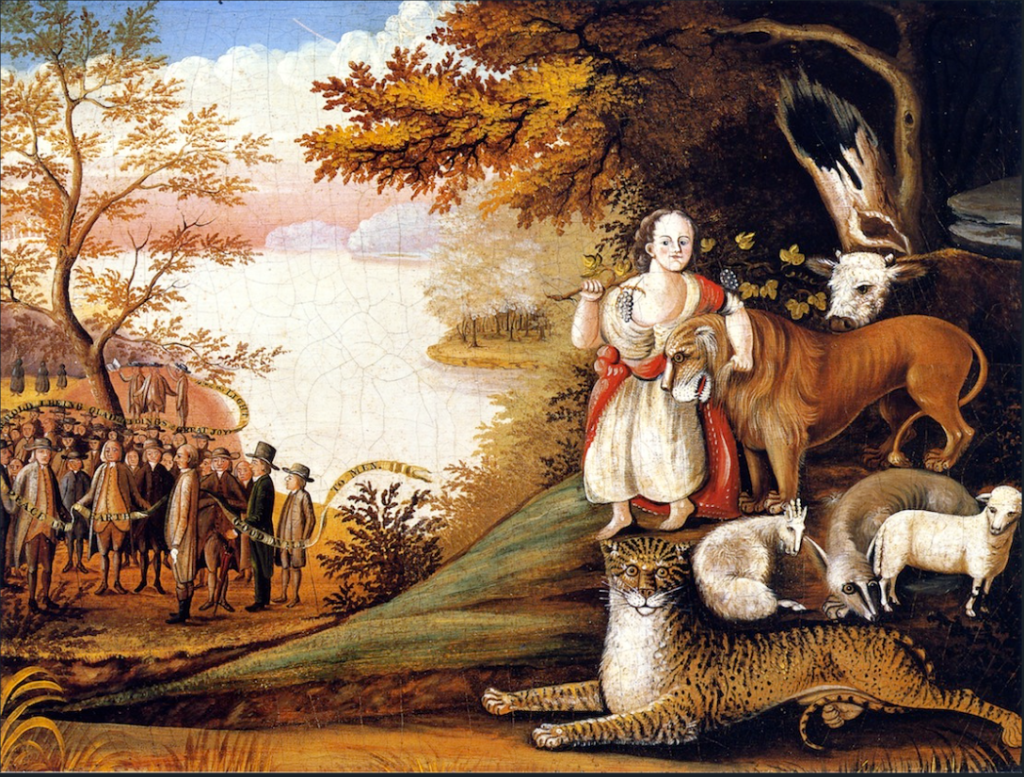
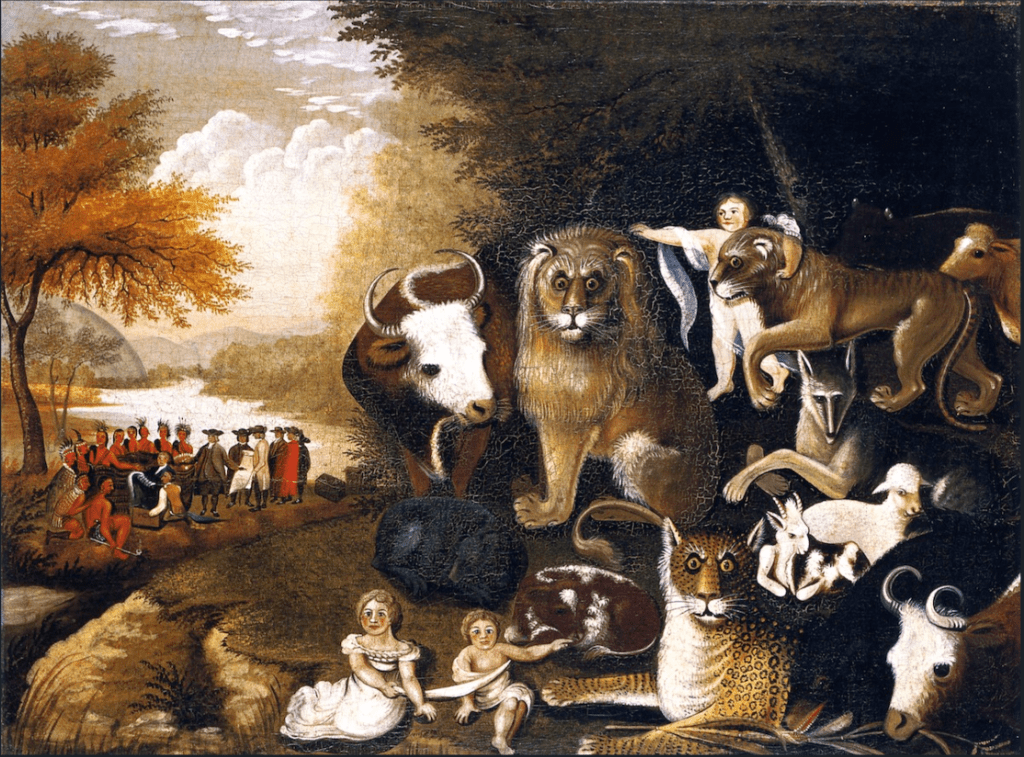
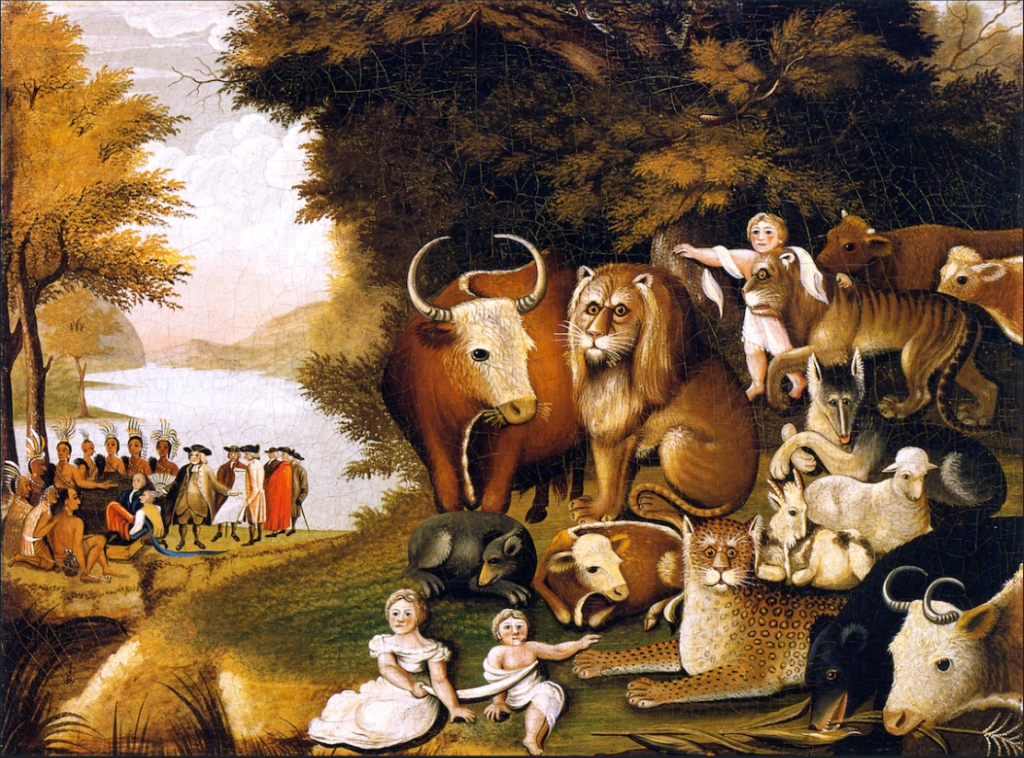
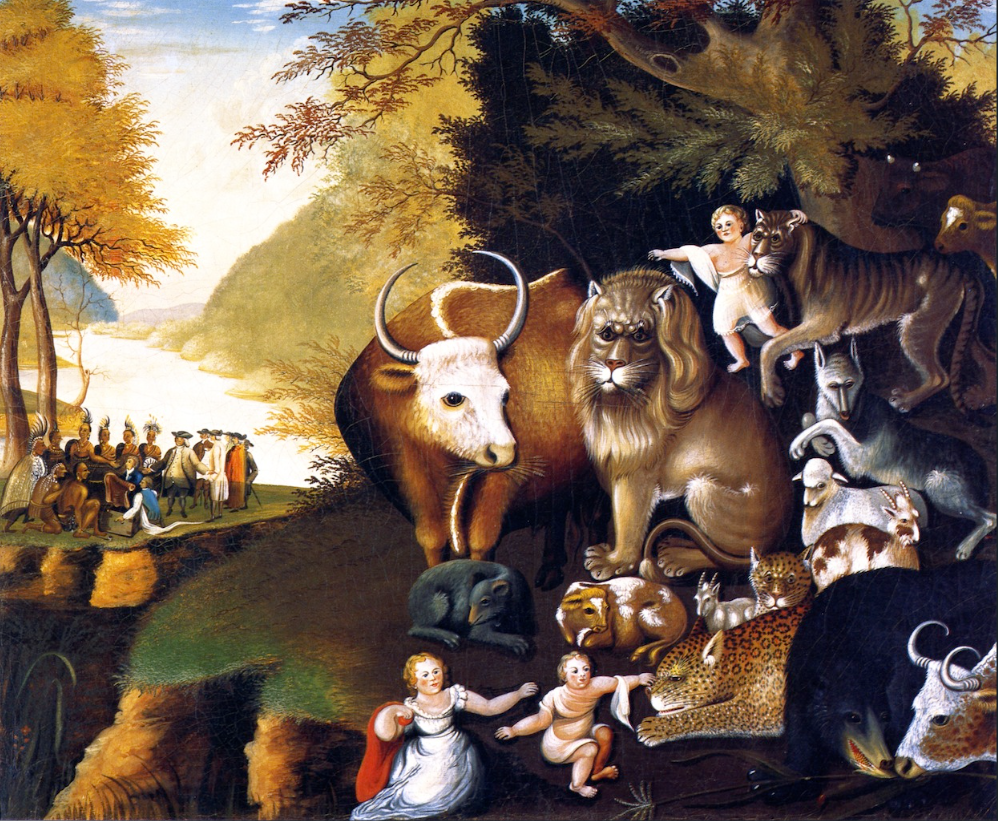
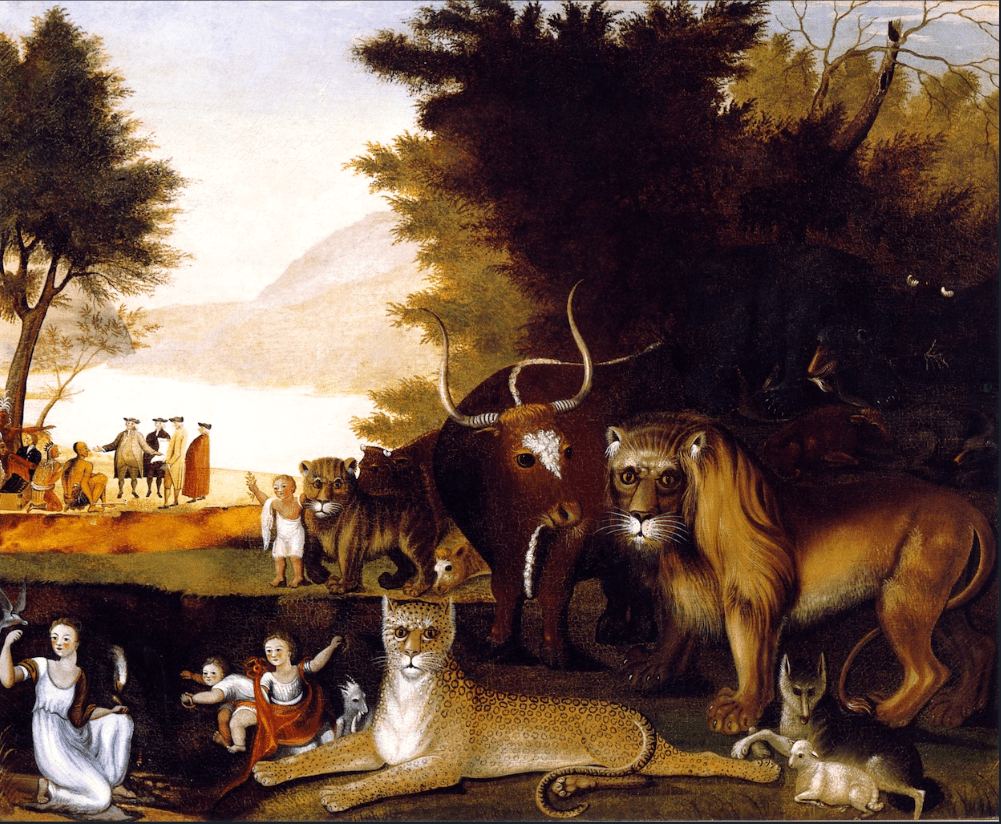
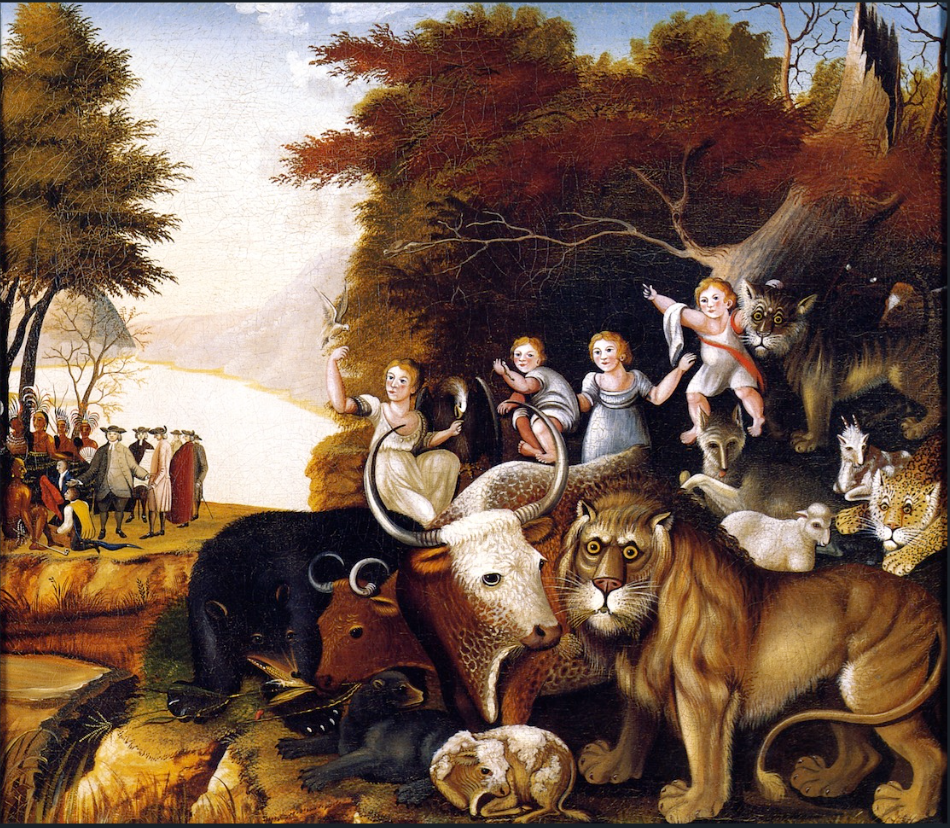
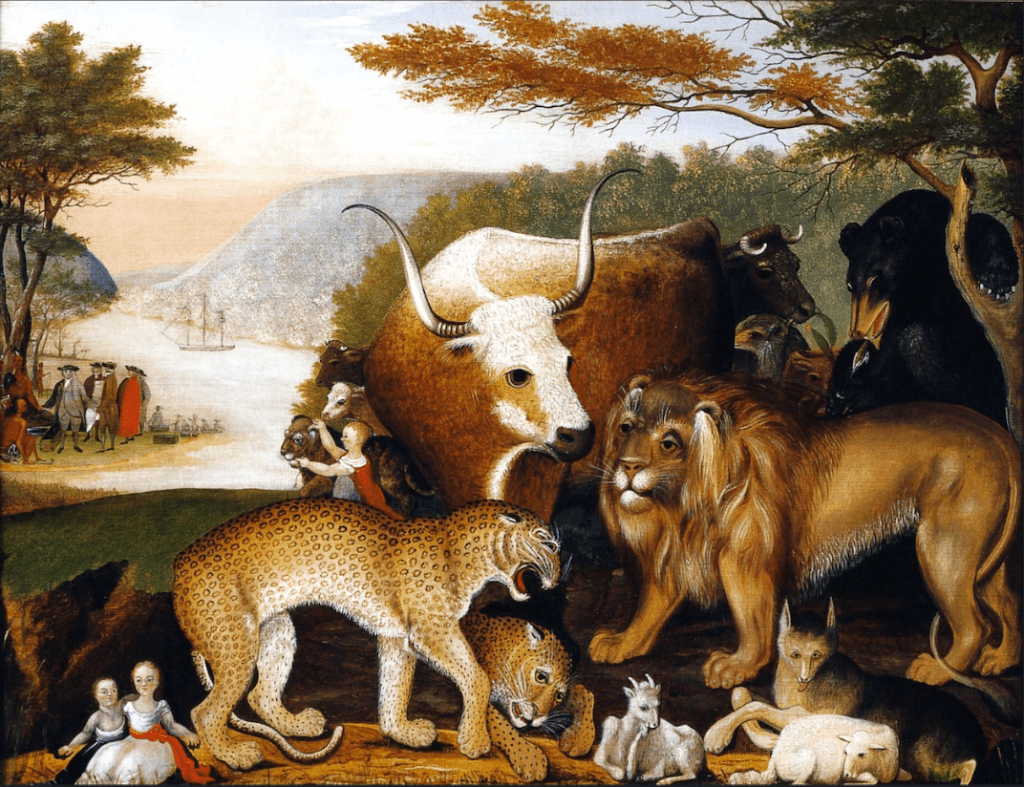
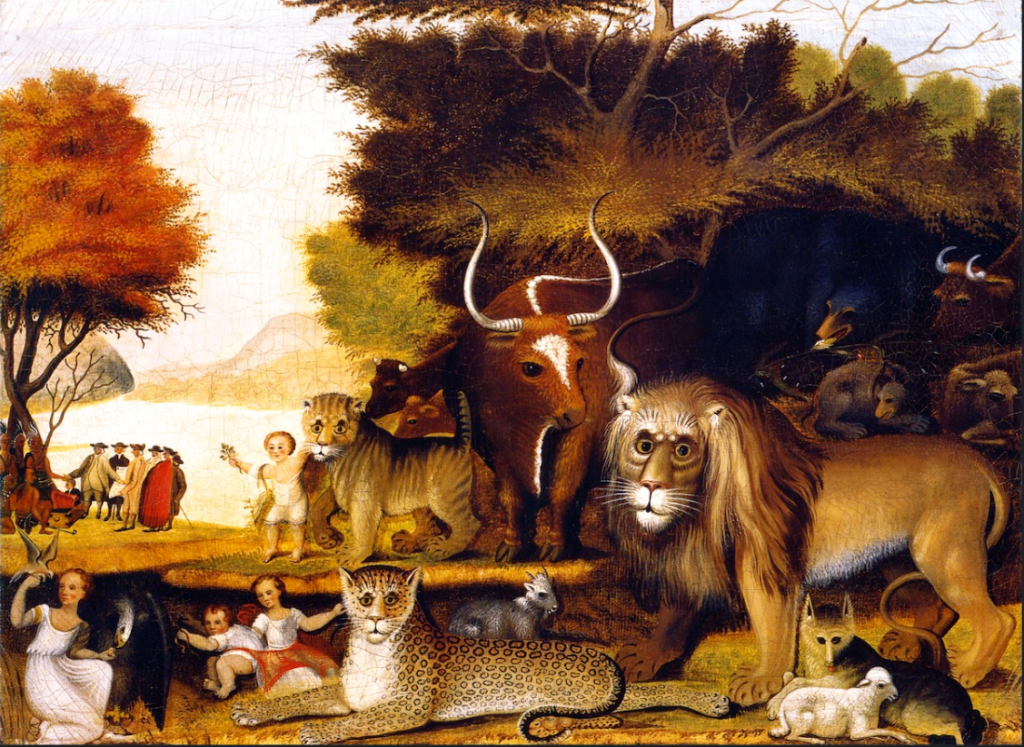
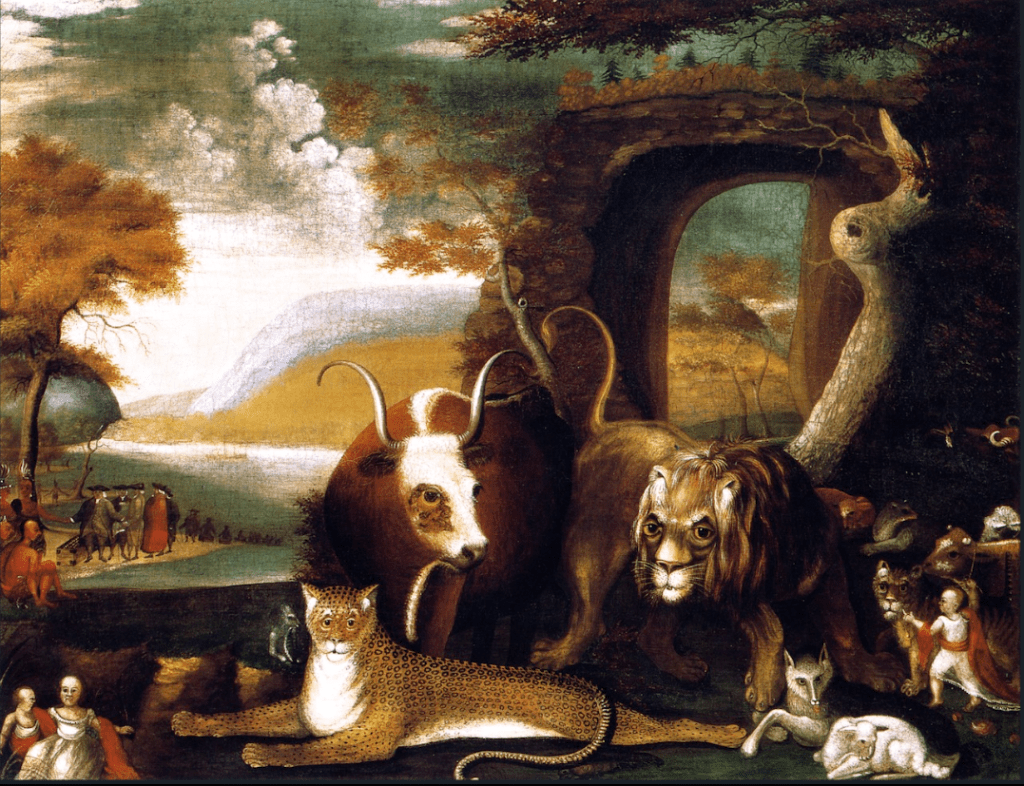
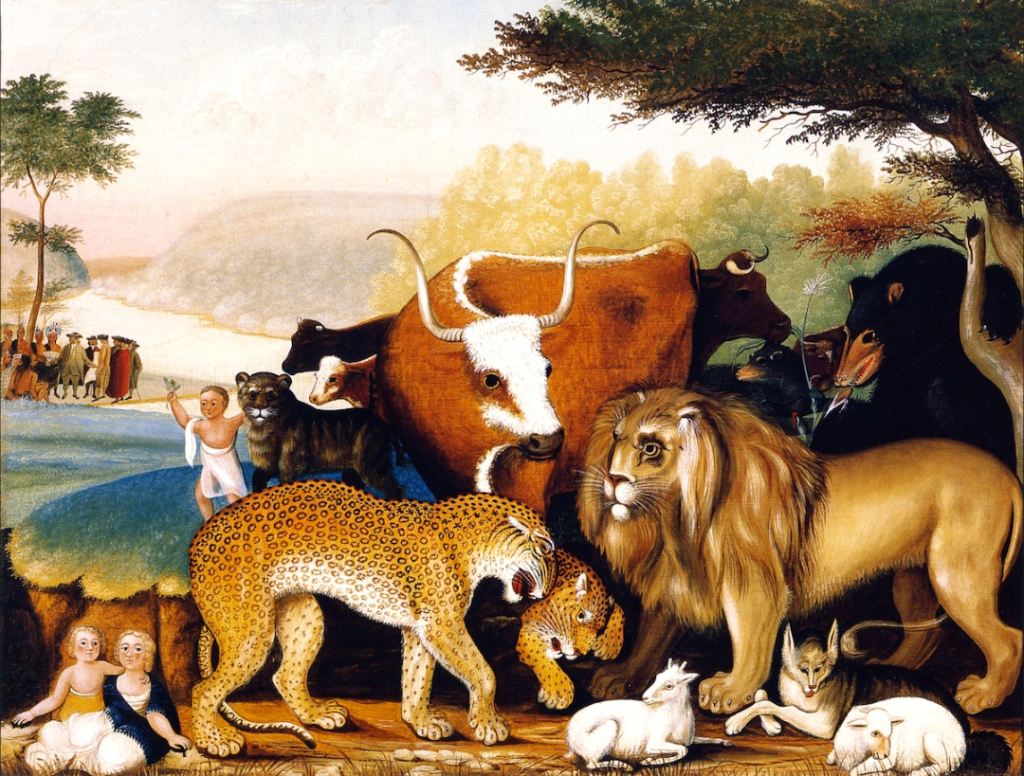
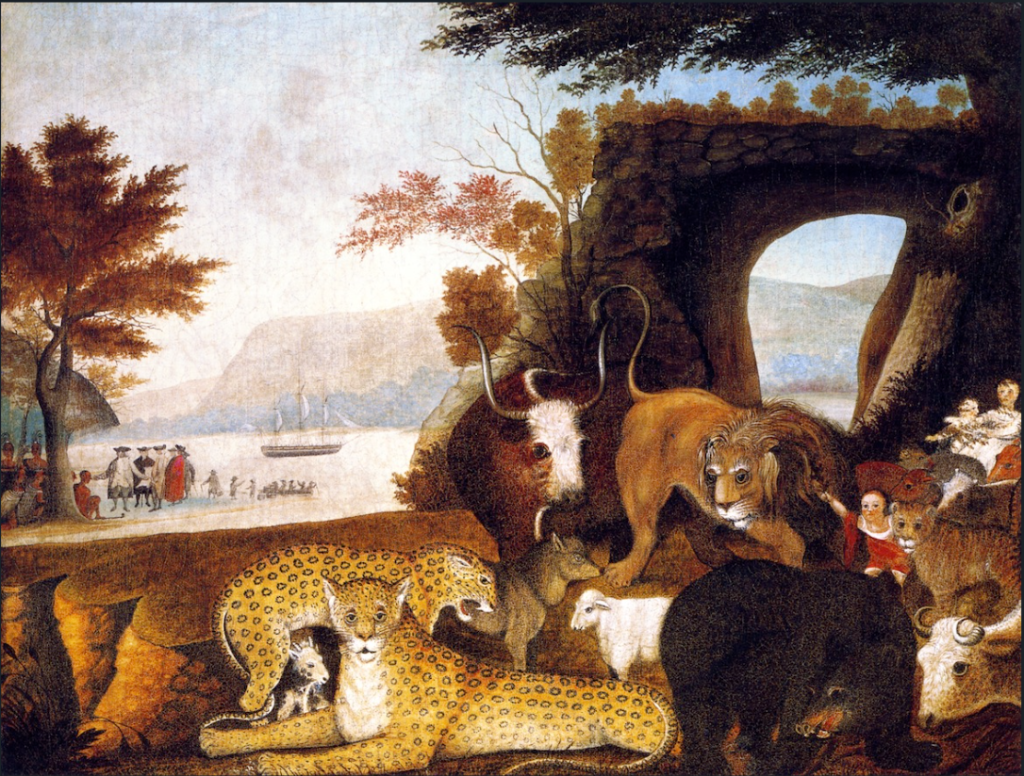
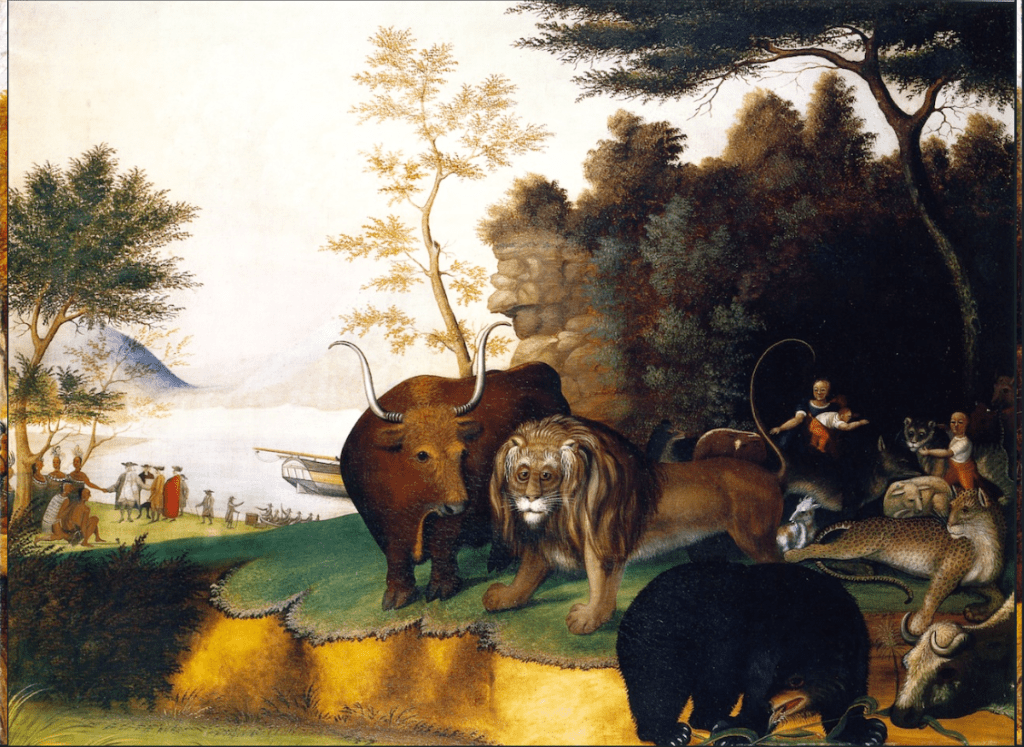
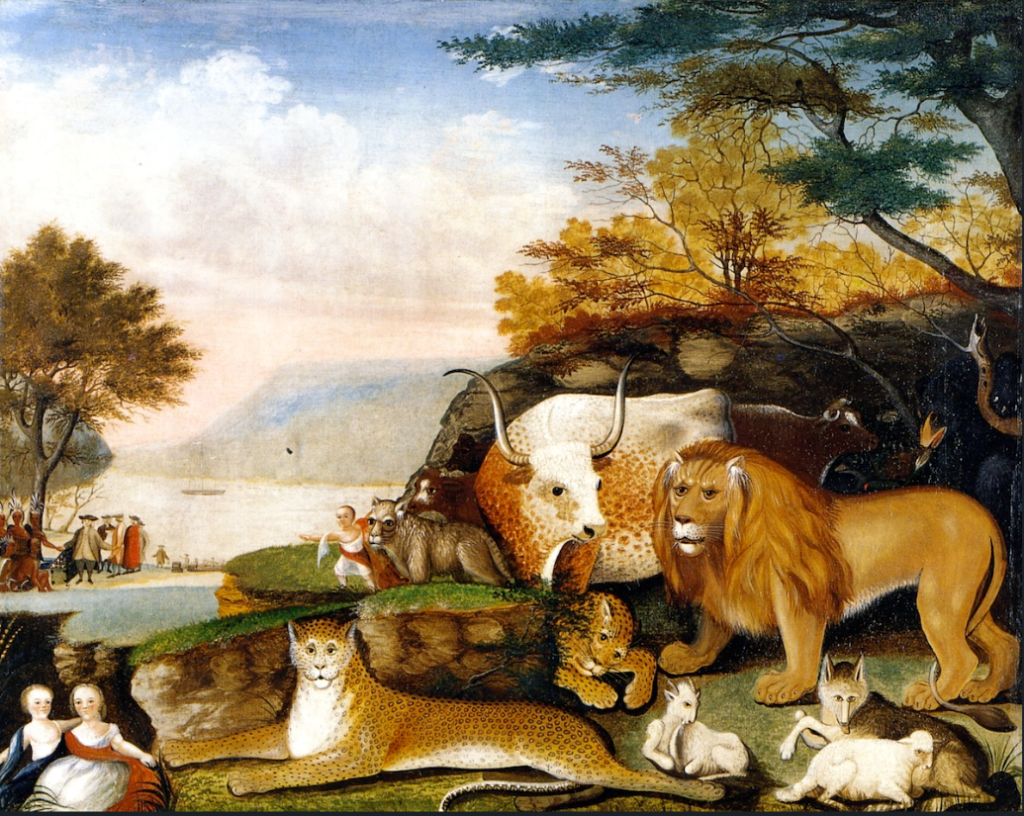
This famous Quaker painter named Edward Hicks (1780-1849) did us a huge favor! Beginning around 1820, Edward began what would become a 62-painting series depicting Isaiah 11:6-9 entitled “The Peaceable Kindom of the Branch”. Commonly these paintings are otherwise known simply as the Peaceable Kingdom. Each painting is like an enormous fingerprint not only expressing the artist life, emotions and his seemingly endless creativity, but also the lasting impression the scriptures would leave on American –especially Pennsylvanian – history and society.

One of the most important things this series gives anyone studying the Mandela Effect is the complete lineup of animals mentioned in Isaiah 11:6 in different arrangements, postures, and expressions. Modern Mandela Effect proponents (MEPs) loudly protest that mugs and rugs at the local Christian bookstore that show lions and lambs lying lazily in lush landscapes prove that there is “residue” left from the reality-bending Effect. However, MEPs skillfully avoid any real discussion regarding works by artists like Edward who’s chief aim was to portray exactly what they read in their own Bibles.
We recently saw one of these paintings in a local Museum. Here are the images we took for you and some documentation of what we captured.

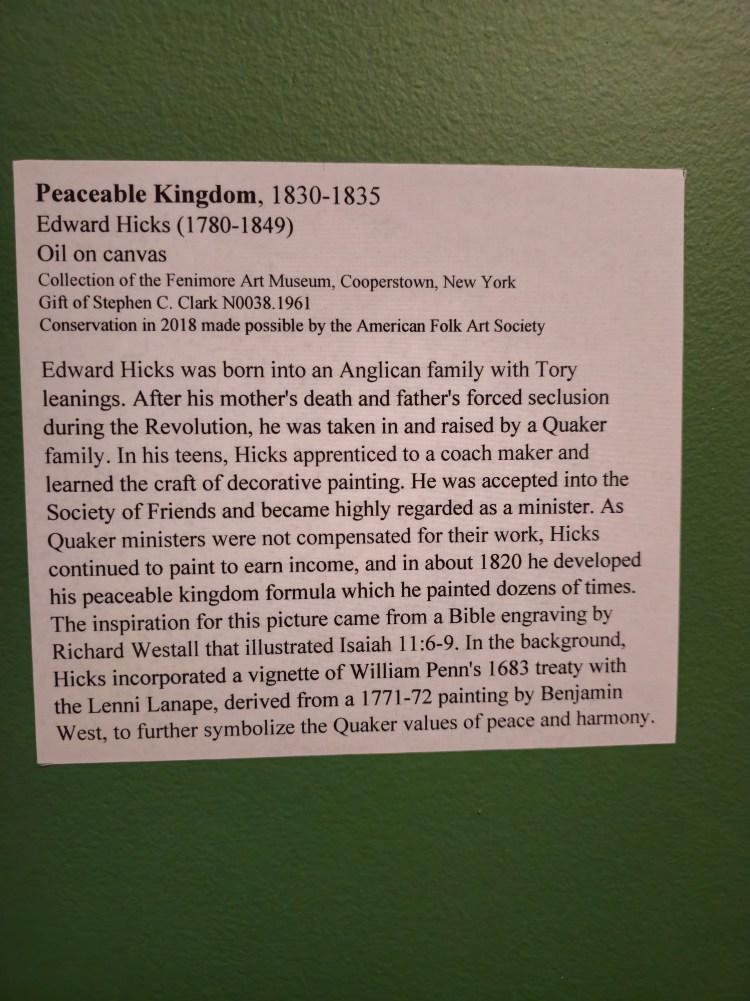
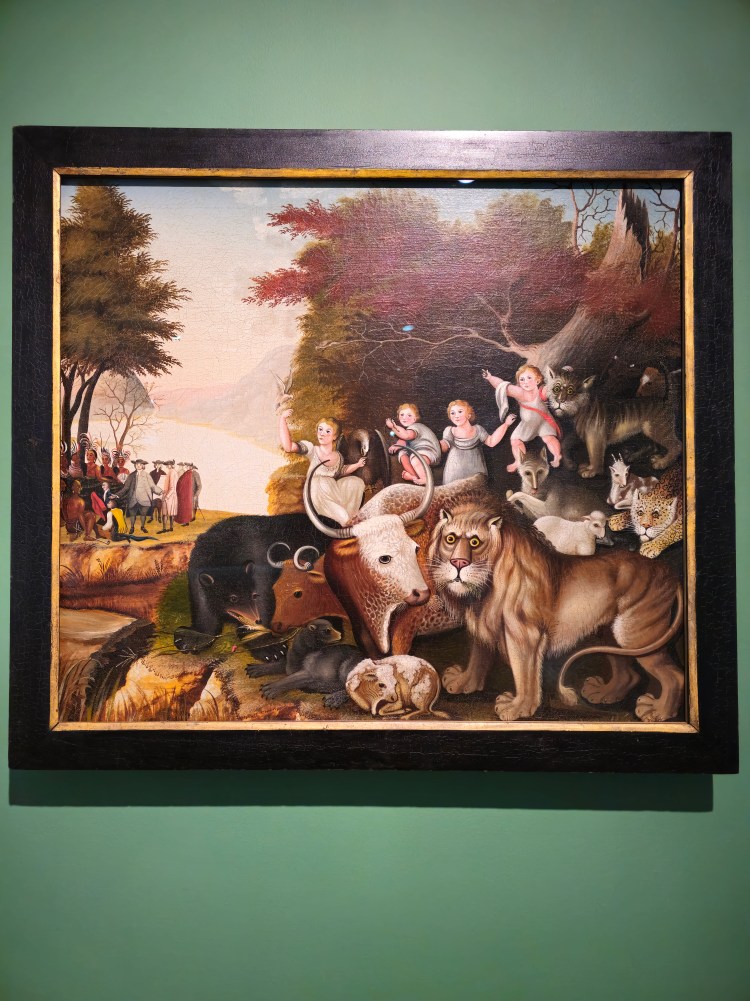
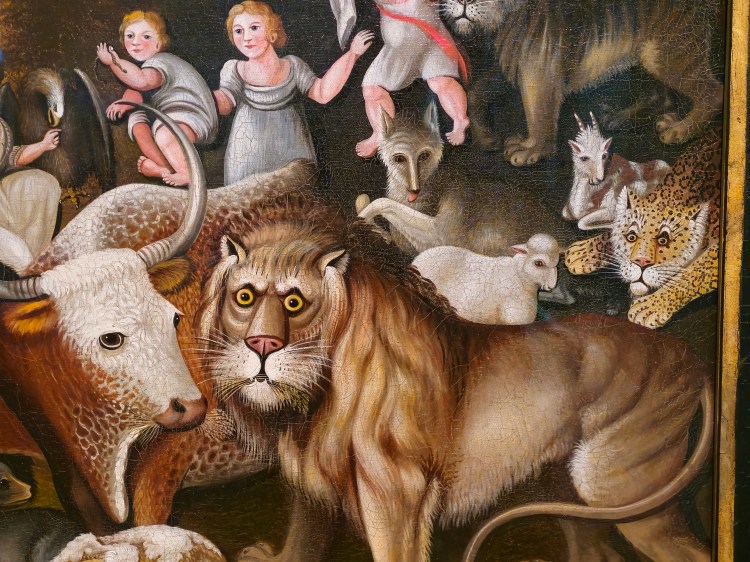
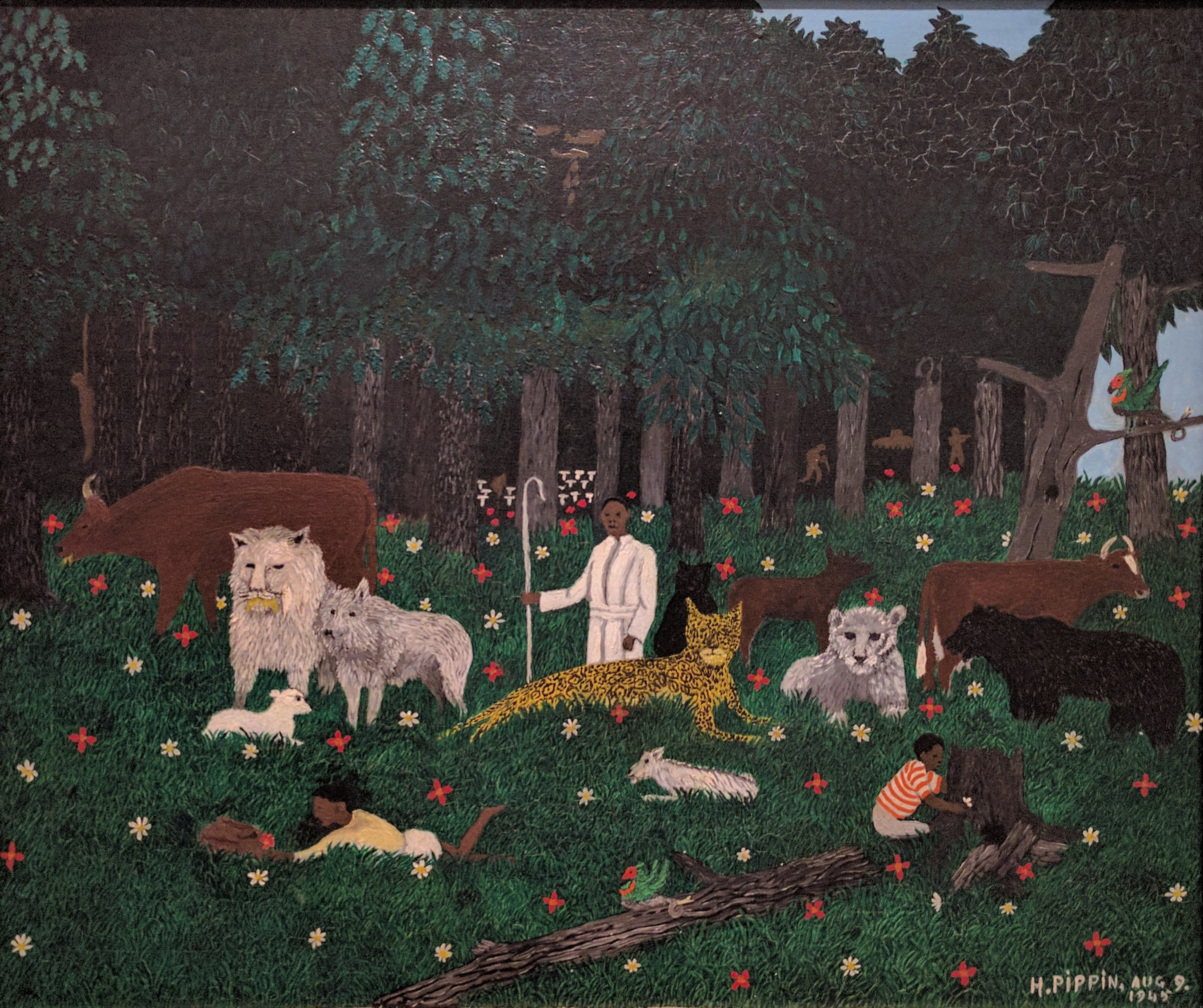
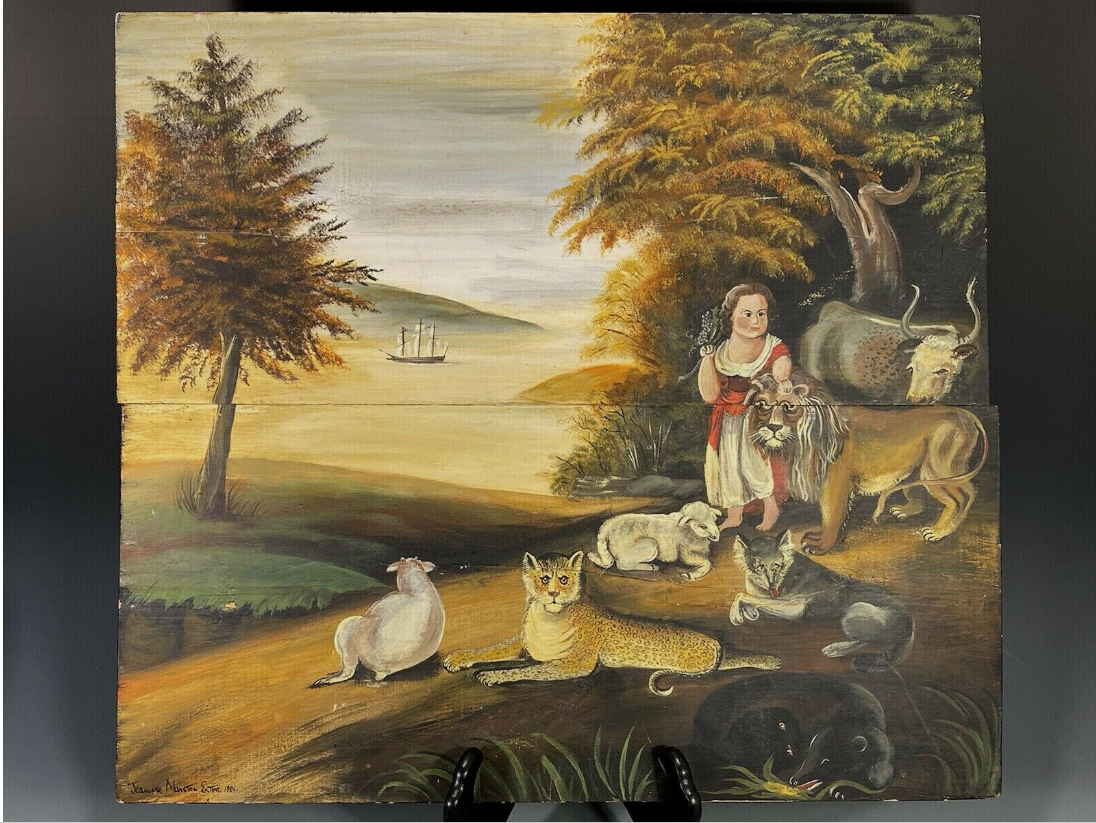
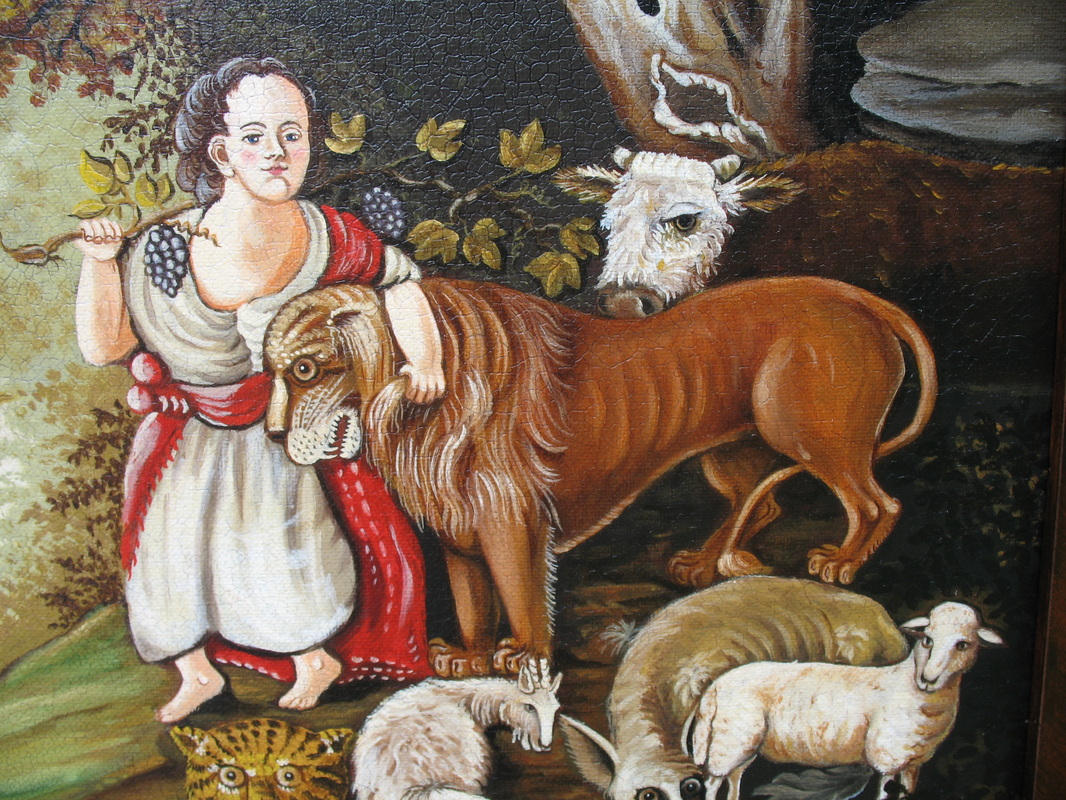
“The Peaceable Kingdom” by Edward Hicks (above) depicts the wolf lying with the lamb as displayed at the Fenimore Art Museum of Cooperstown, NY (October 6th, 2023). The following version was photographed by Joseph Armstrong with his Samsung S23 Ultra. Four other sound-minded English-speaking adults witnessed this painting. (Please remember that Edward Hix produced 62 versions that still exist of “The Peaceable Kingdom” from around 1820 which depict a similar setting and do not represent the lion lying down with the lamb in any of them.)
There is much more to this artwork than meets the eye! Read more about the history and the man behind the paintings in “ART REVIEW; Finding Endless Conflict Hidden in a Peaceable Kingdom” and “Edward Hicks” by Wikipedia. We will add more resources as we are able.
The Many Faces of the Peaceable Kingdom
Take a close look at the diverse arrangments of Hick’s peaceable menagerie. You will begin to notice some interesting patterns that show, not only the thought process, humor, and genius of the painter, but also illustrate Biblical truths!
For instance, we noticed that the animals paired in Isaiah 11:6 are arranged by size in the verse itself! The wolf and lamb (the smallest predator and prey) consistently play a lesser tertiary role in the composition. Very often our sleek leopard and sometimes clumsy goat head up the foreground as our mid-range pair. Lastly, our primary focus is directed again and again to the face of the lordly lion (who seems to have very mixed emotions about the whole concept) and his friend the iconic ox and largest of all. Taking the place of his younger family members (Is. 11:6b), the ox serves his post as a companion of both the lion and often an equally intimidating black bear.
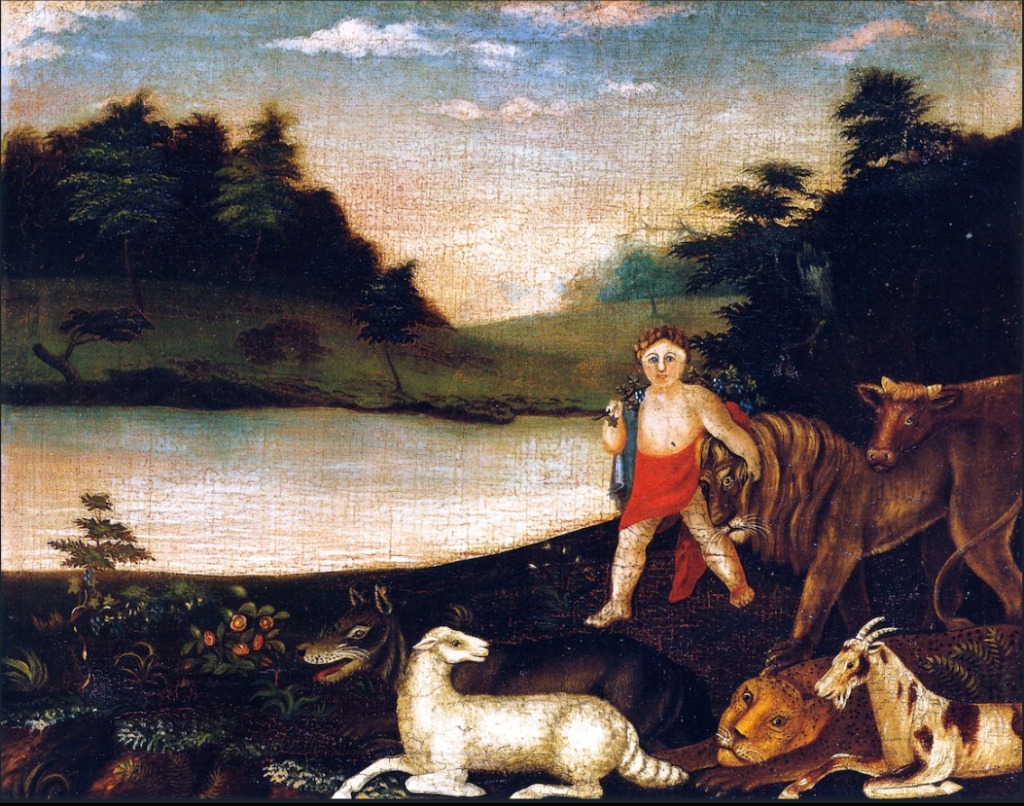
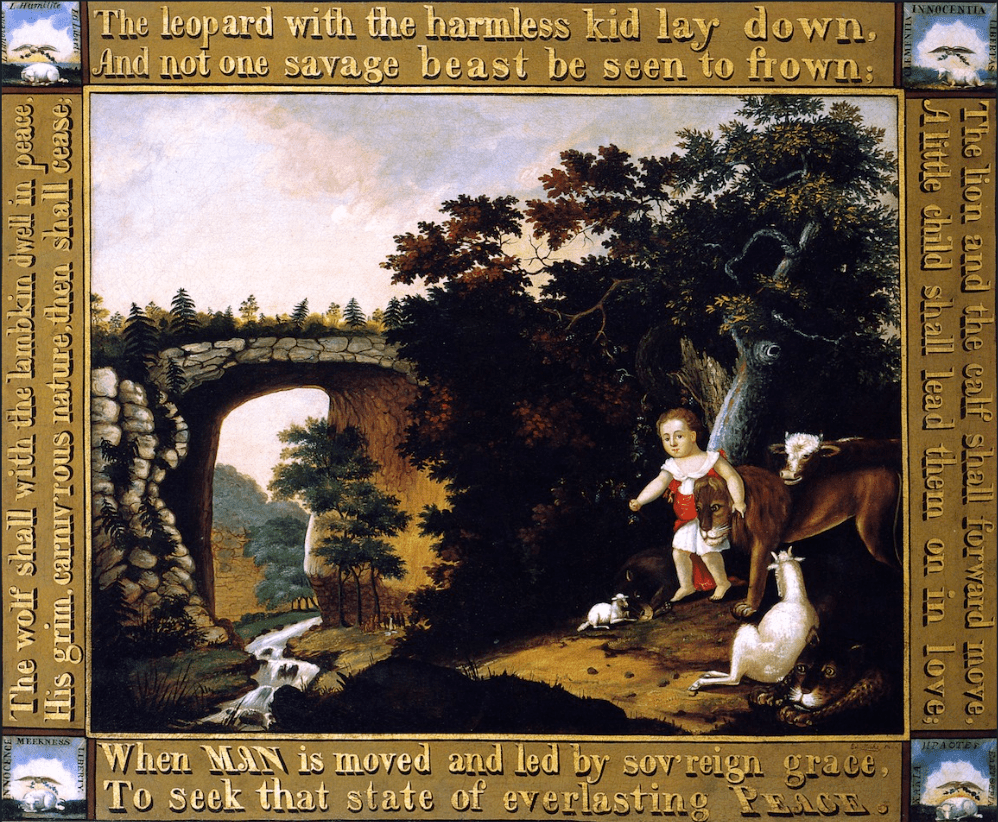
These 62 similar yet unique paintings display the complex evolution of Naïve art from a distinctly Quaker artist from the early to mid-1800s (they may look a little funny, but they aren’t AI). Together, these paintings form a redoubtable body of external witness to the biblical reading of “wolf”, not “lion.”
Challenge #2
Can you find a version of the Peaceable Kingdom which we have not featured? We feature 47 of the existing 62. Bonus bragging rights if you know what year it was painted!
Note: To the best of our knowledge, these paintings are arranged in chronological order. Click on any of the images below to view them in slideshow mode.














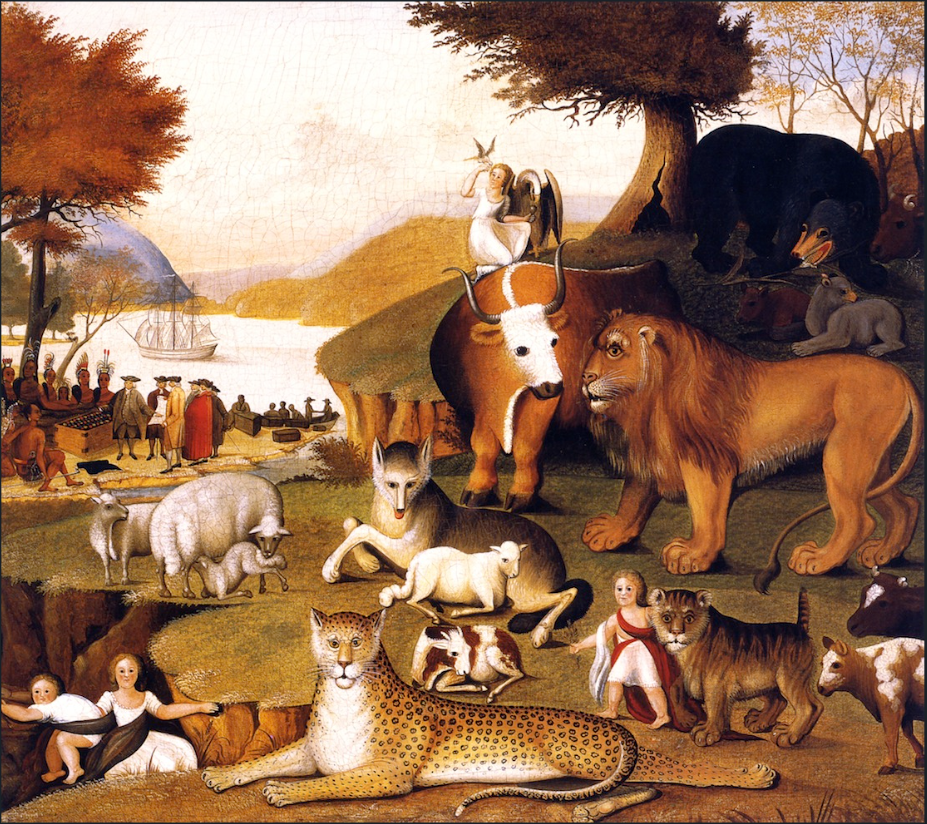

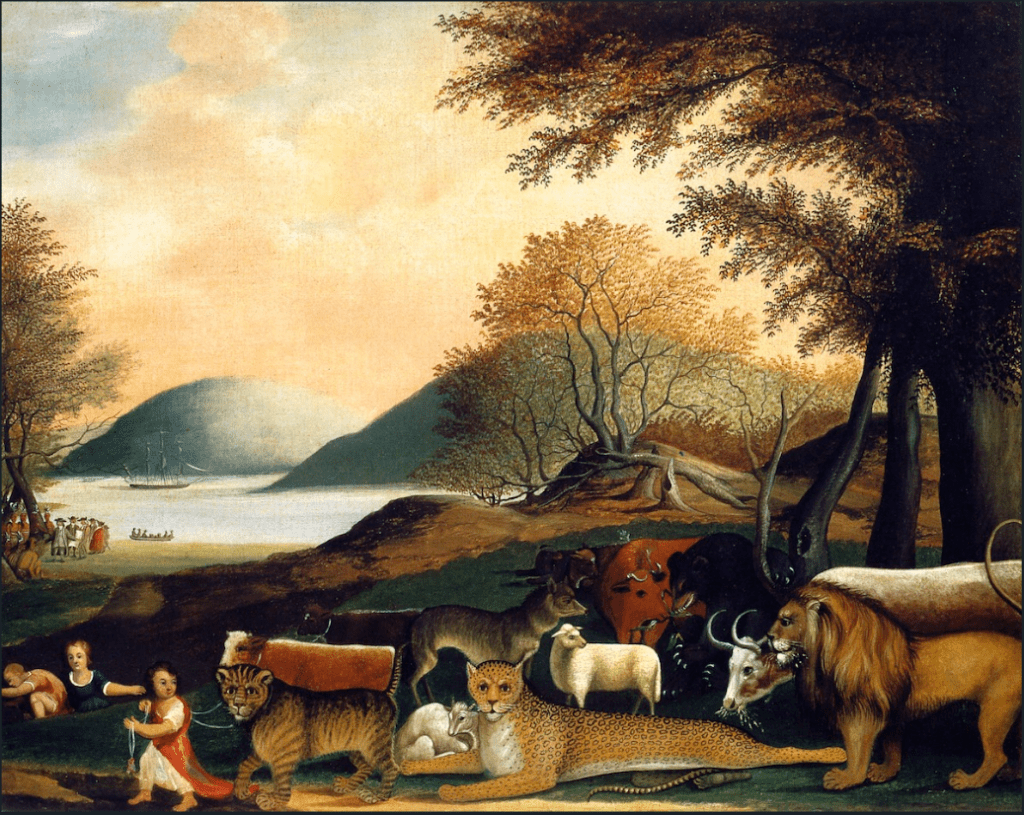

Other Historical Pieces
Here are a few more samples from history showcasing how D-Wave computers have gone back in time and completely changed the fabric of reality. Capable of photoshopping in a wolf to some of the oldest works of Christian art available, yet they somehow completely missed the blankets and coffee mugs at your local Christian bookstore. Stupid computers.
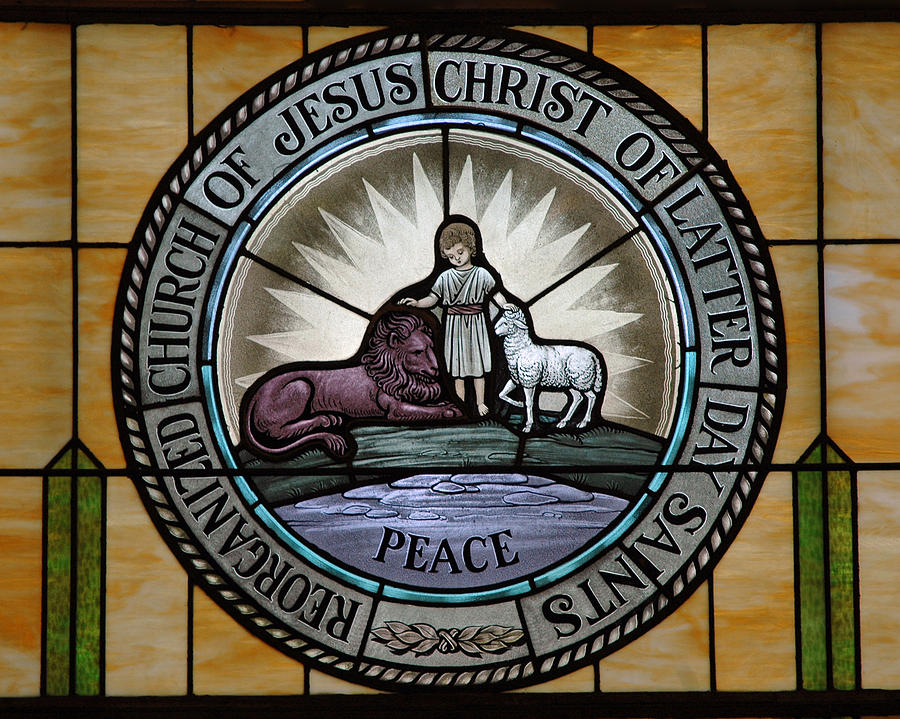
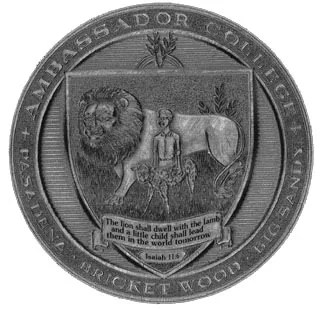
Note: James Muller does portray the lion with the little child and a lamb and an emblem for the Reorganized Chursh of Jesus Christ of Latter-Day Saints are the only exception we have found predating the 1900s.
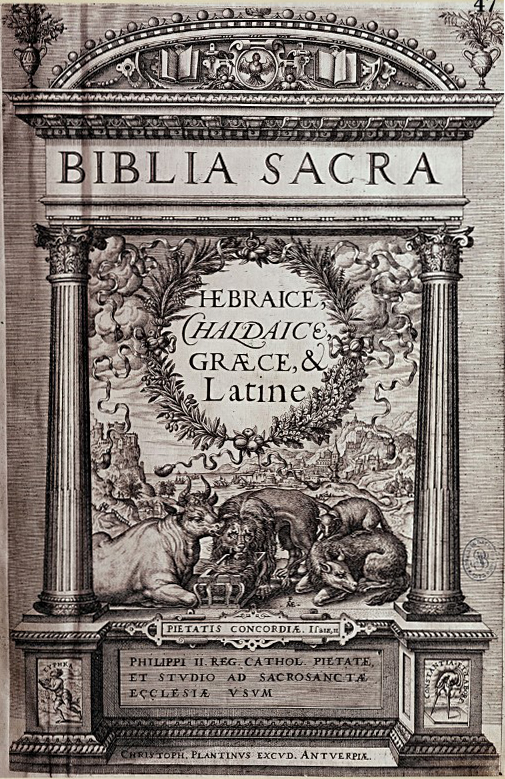

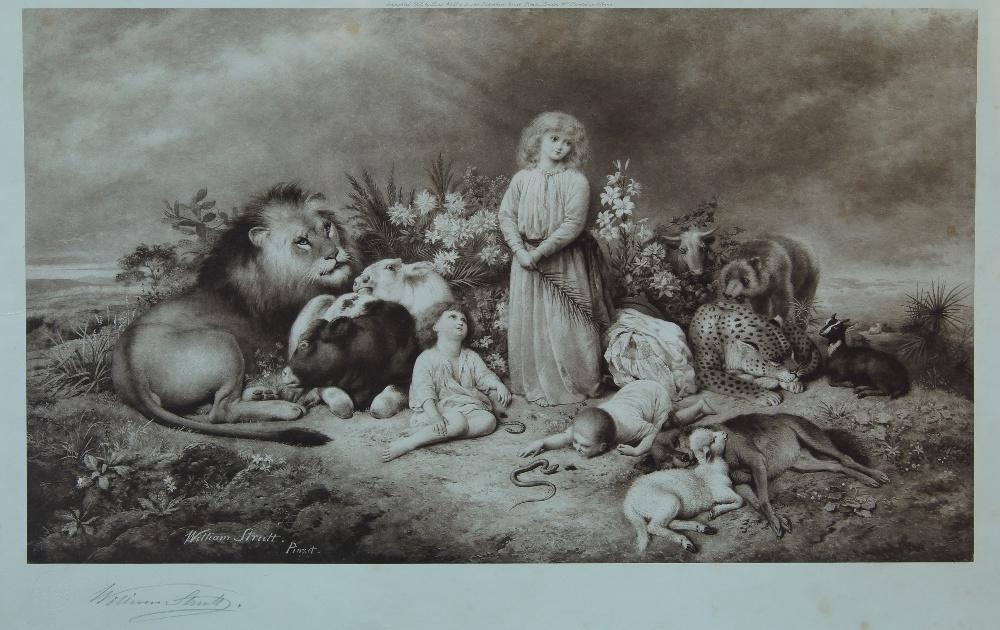
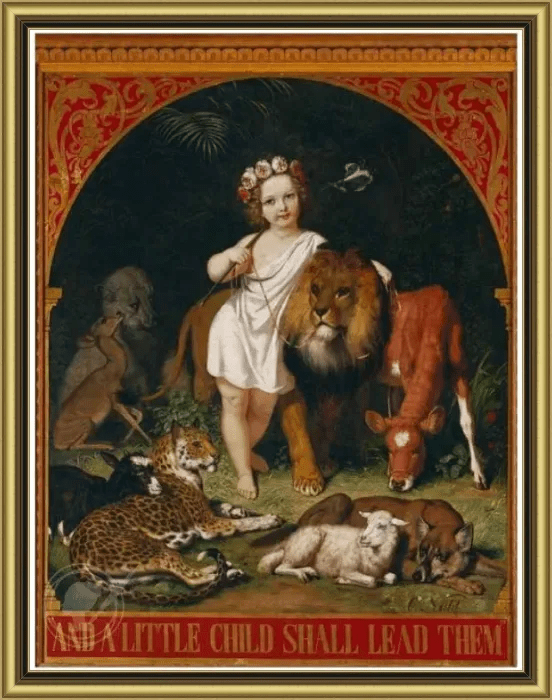
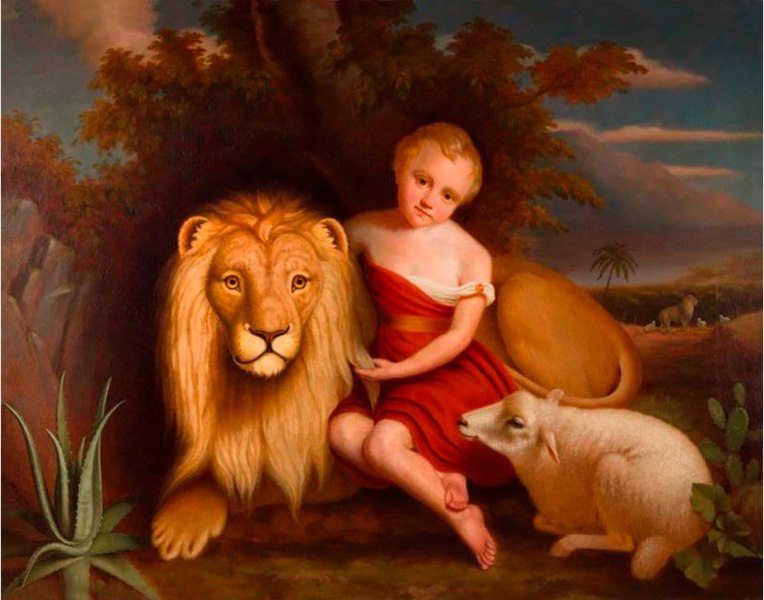
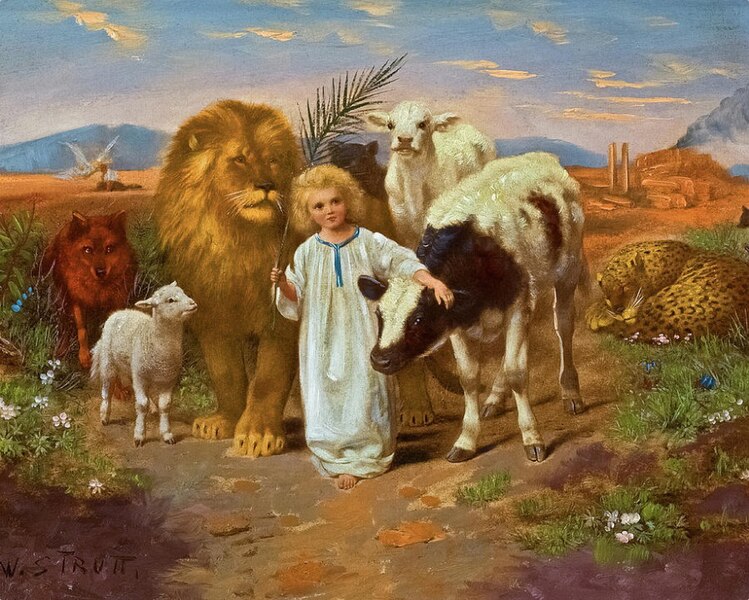
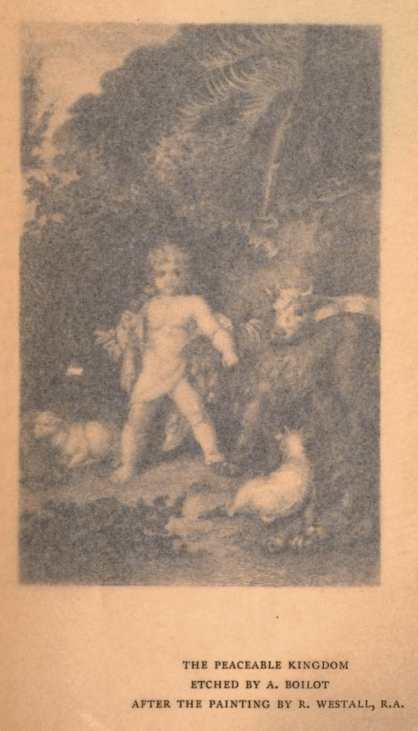
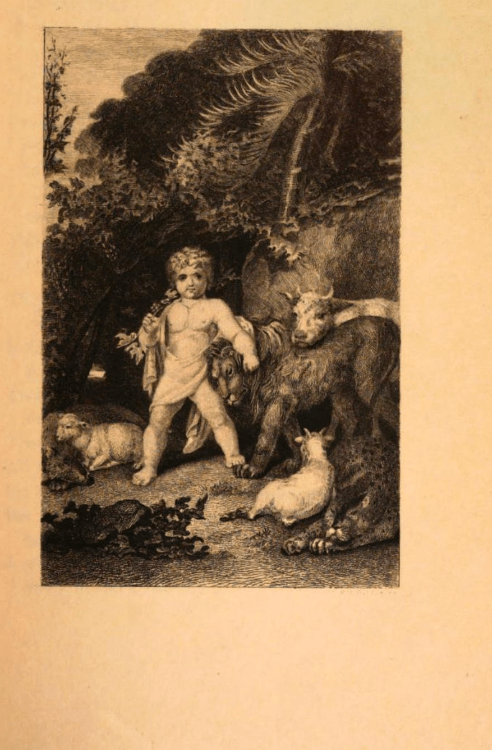
- *Note: A scan of the Peaceable Kingdom from “The Holy Bible: Containing the Old and New Testaments and the Apocrypha” (Vol. 7) also clearly depicts the wolf and lamb together on page 162. (Due to a scanner error, the page is included 4 times in the document with 2 different scan qualities. Evidently, in the original document, the Illustration is printed twice. Once with poor density and a caption with information about the artist, and once with high density and no caption.)
Modern Art Says “Lion”…Sort of.
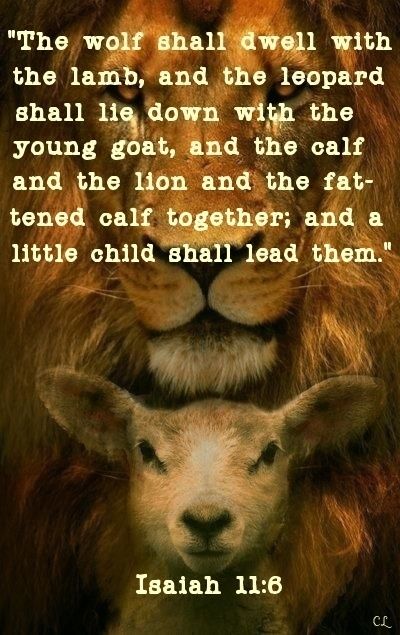
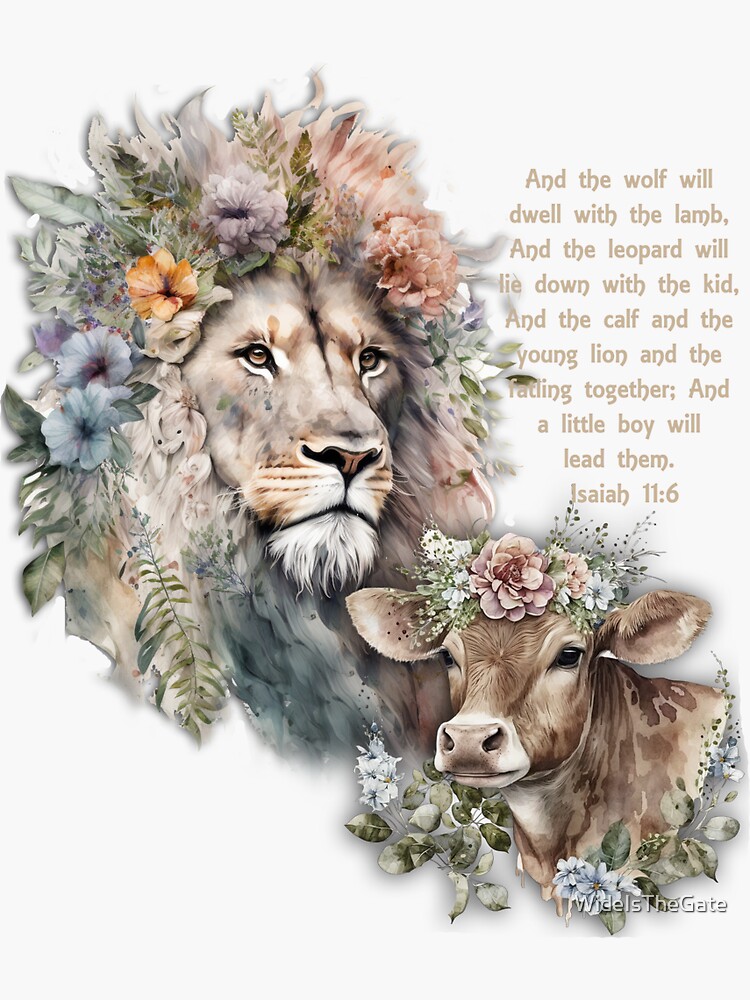
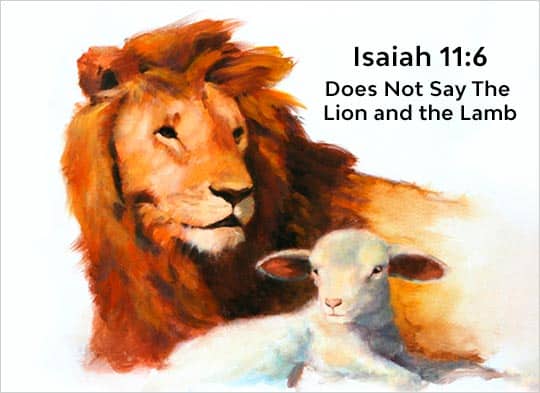
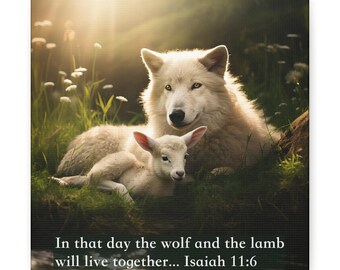
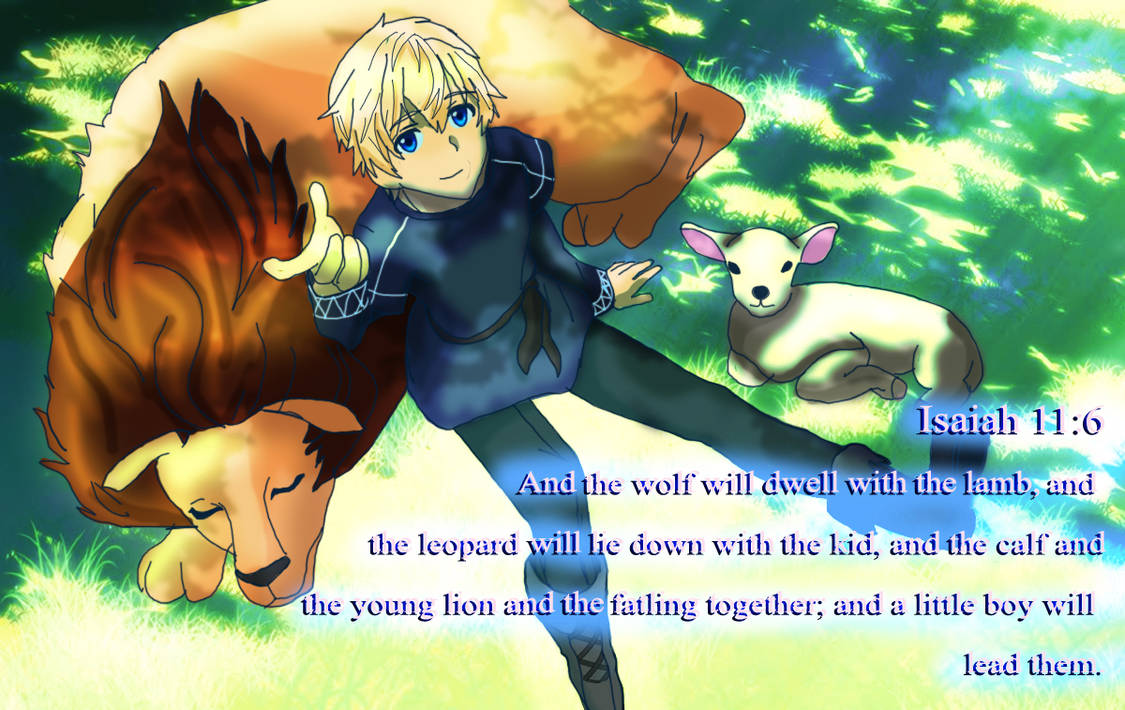
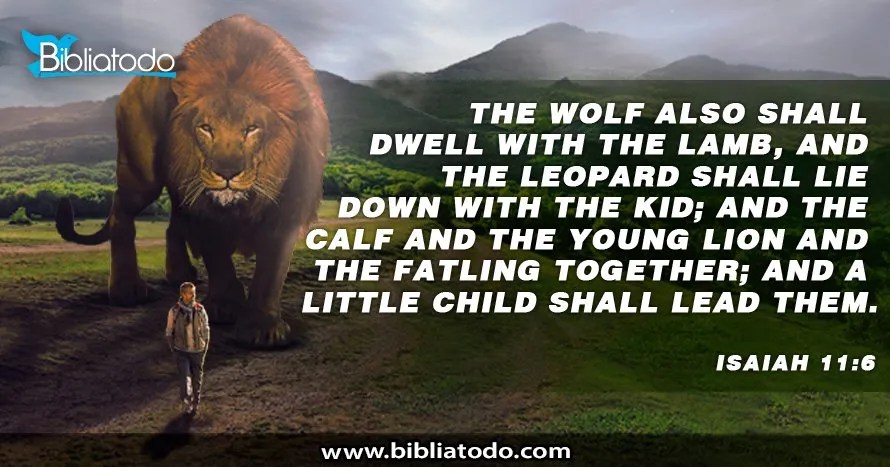
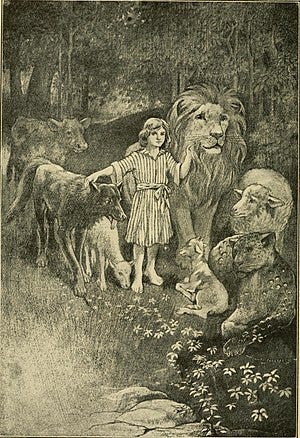
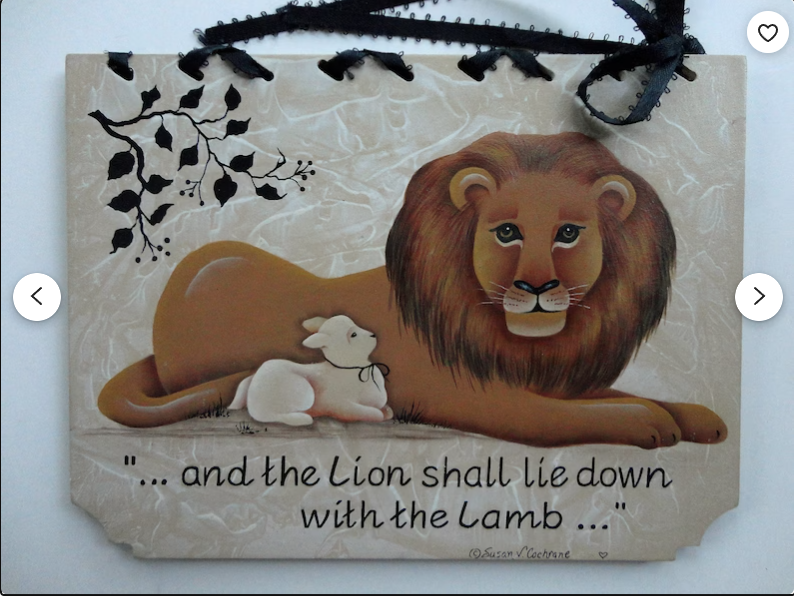
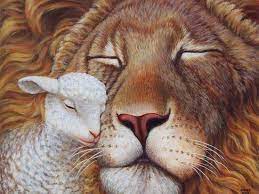
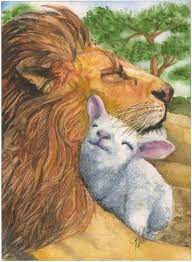
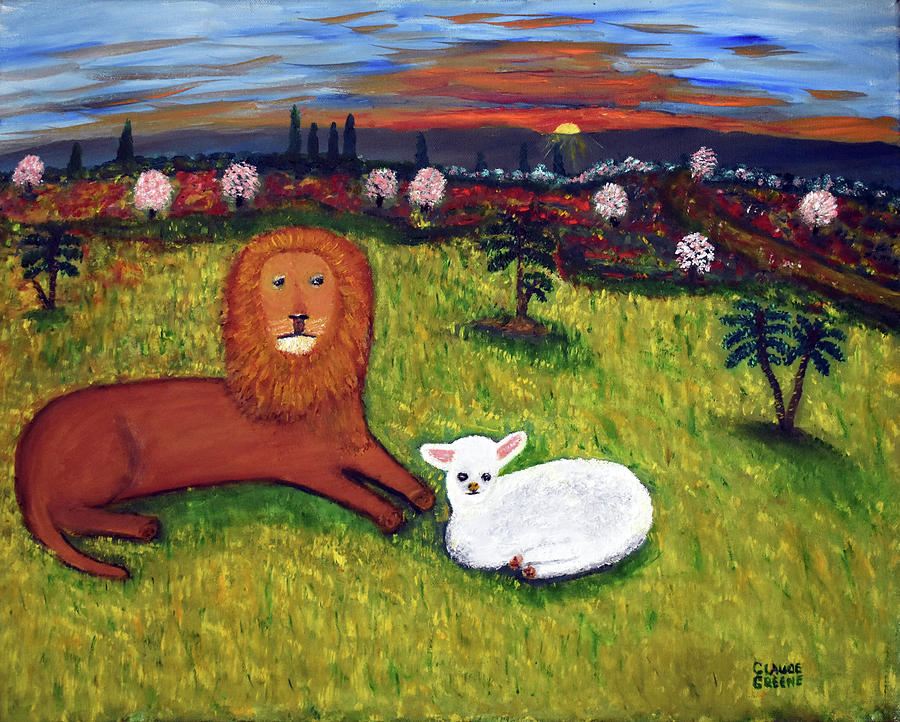
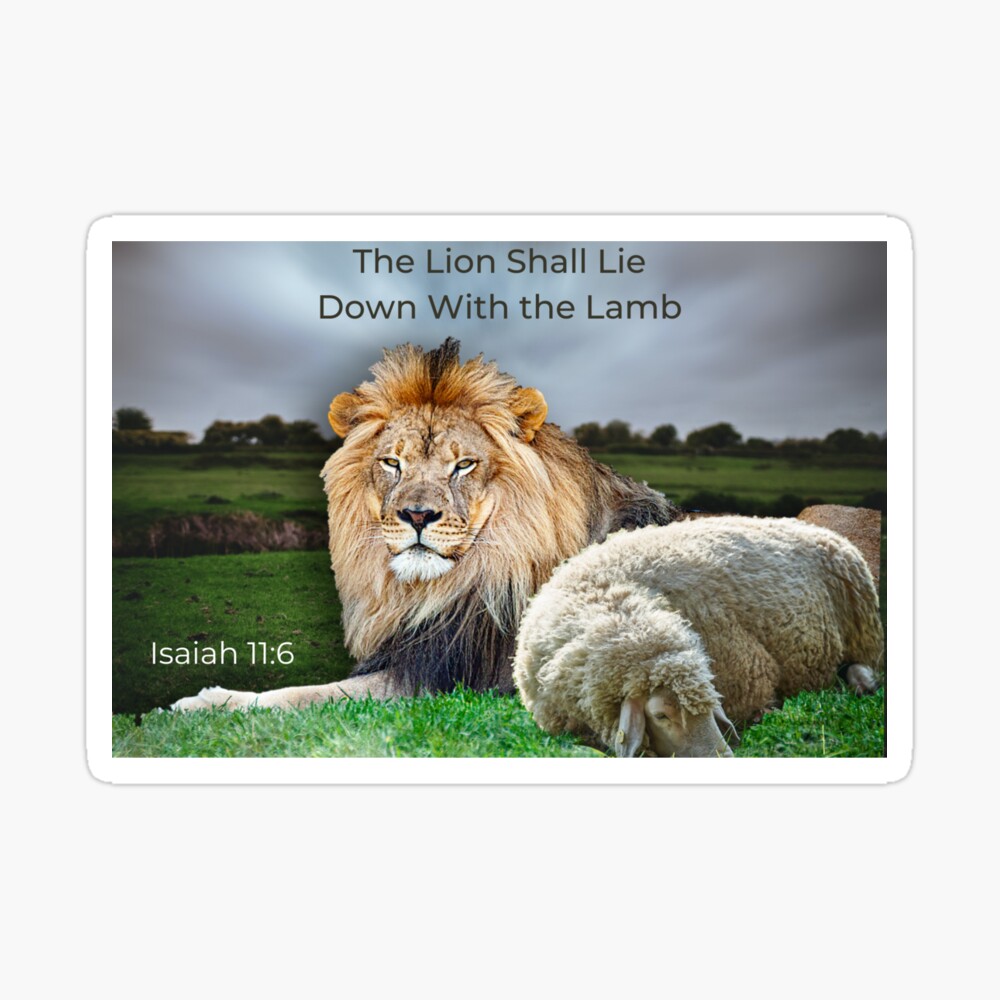
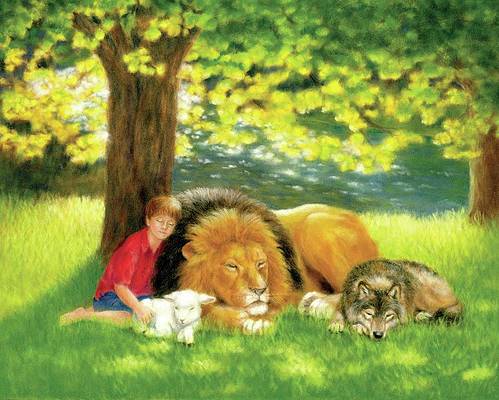
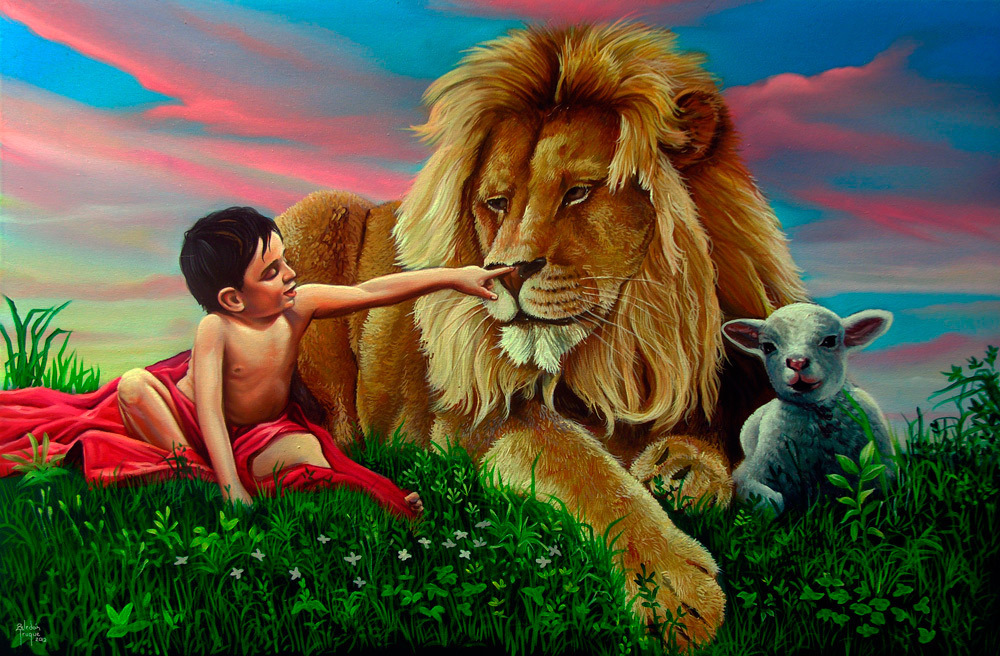
We were actually surprised to find that there are far fewer images that misrepresent the text than Mandelites claim! Next time you go to the Christian book store and see all those pictures featuring lions and lambs, you may want to pay closer attention! There are actually very few misquotations of this verse available even in popular art! It’s mostly just lions laying with lambs.
Challenge #3: Can you find each place where the lion is in the photo, but the wolf is in the text?
Challenge #4: Send us an image (that you did not make for this challenge) that features the animals described in Isaiah 11 that pairs the lion rather than the wolf with the lamb.
Read more about the significance of “lion and lamb symbolism in “The lamb and lion“.
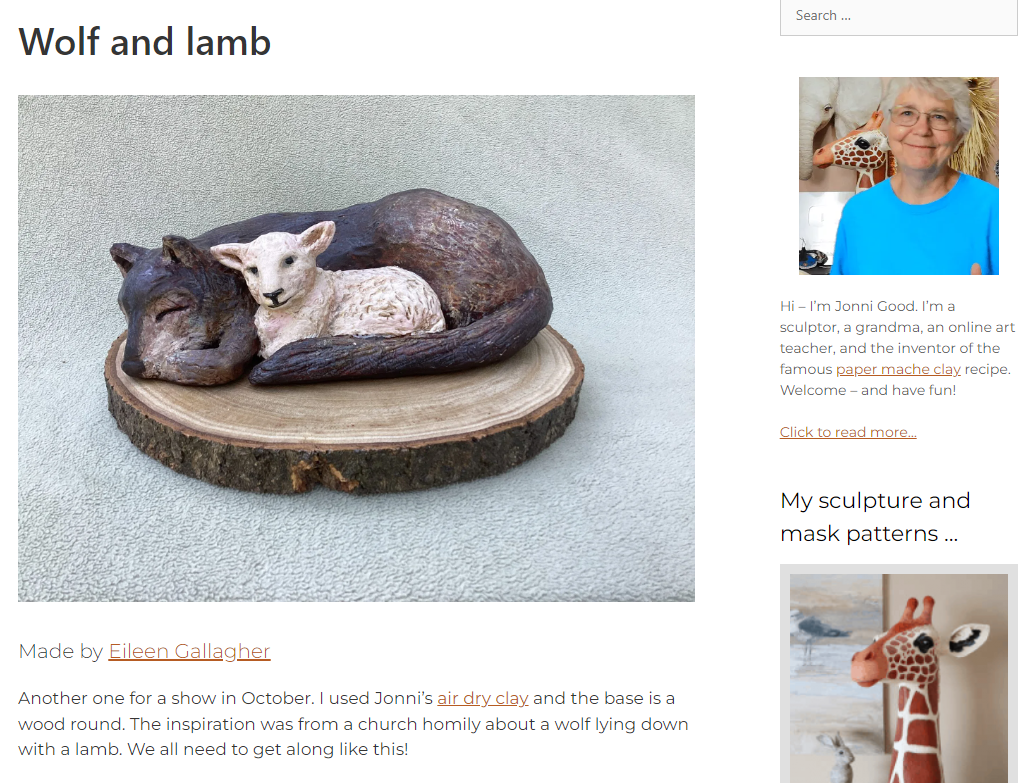
Modern Depictions of Isaiah 11:6, Revelation 5:5, 12, etc.

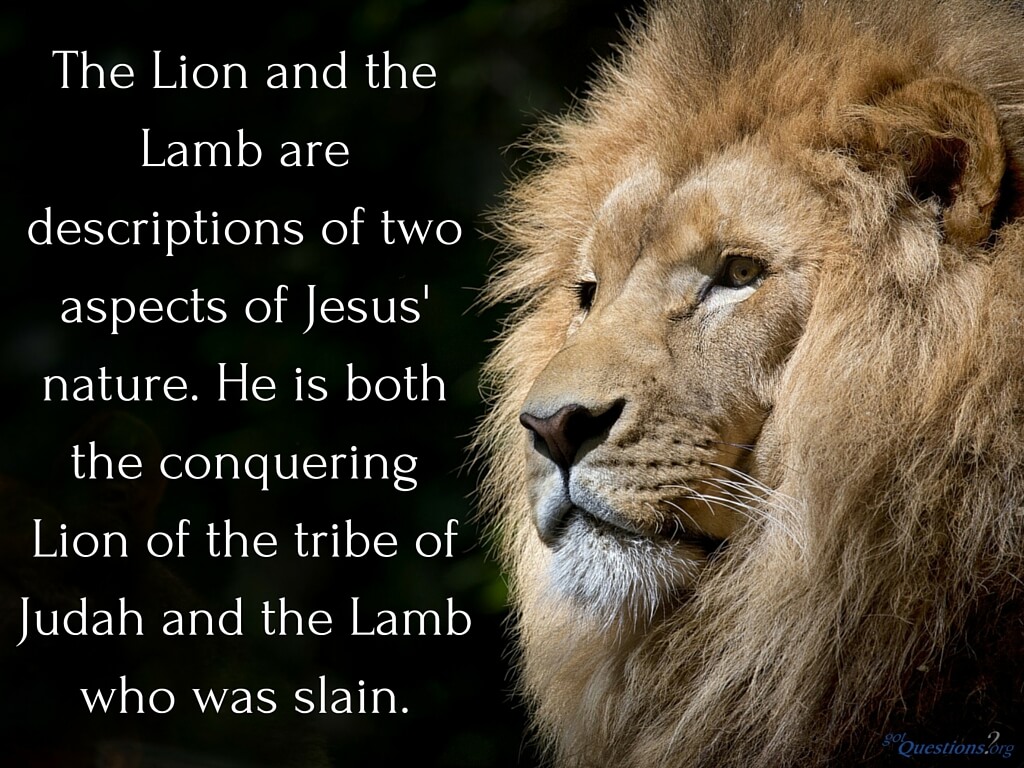
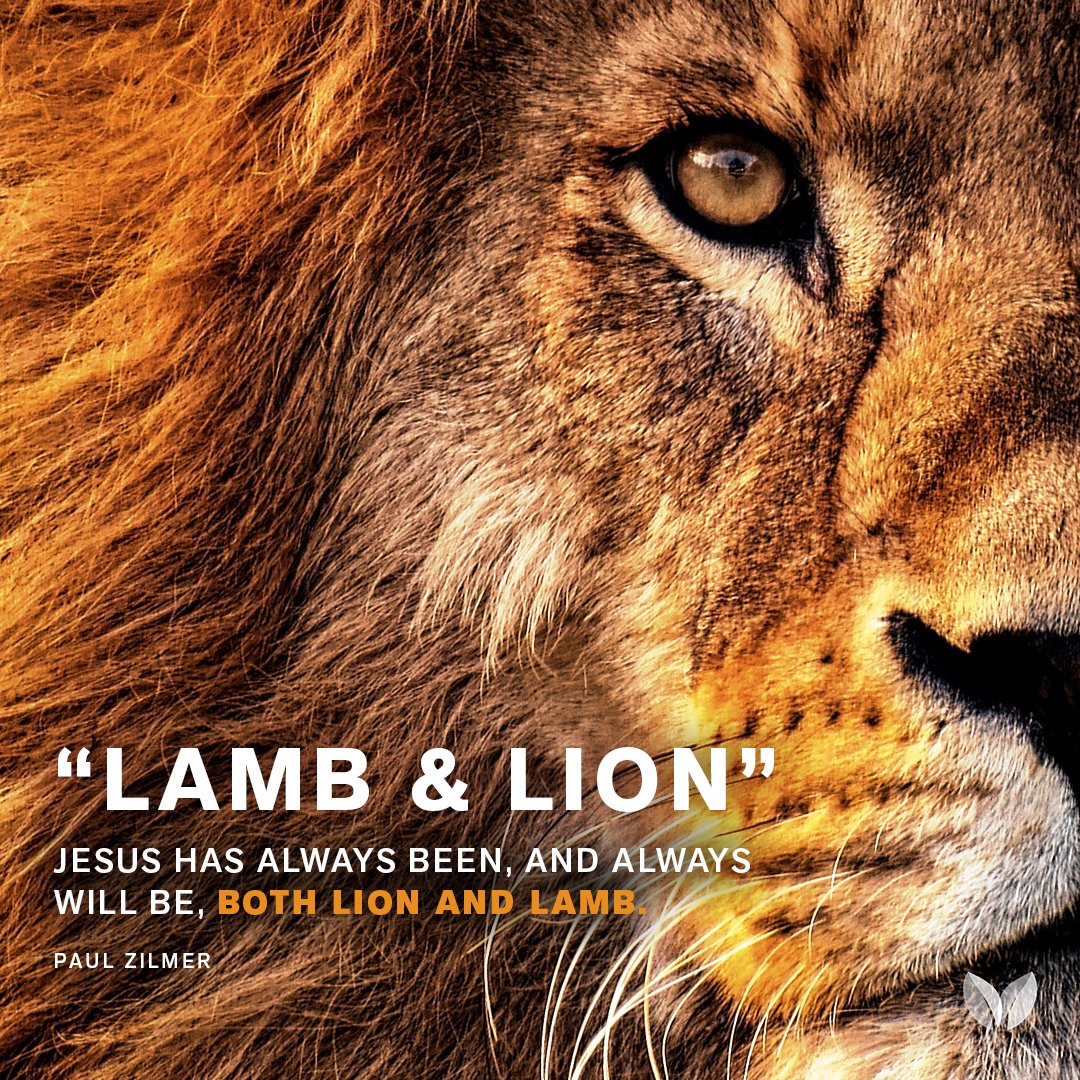
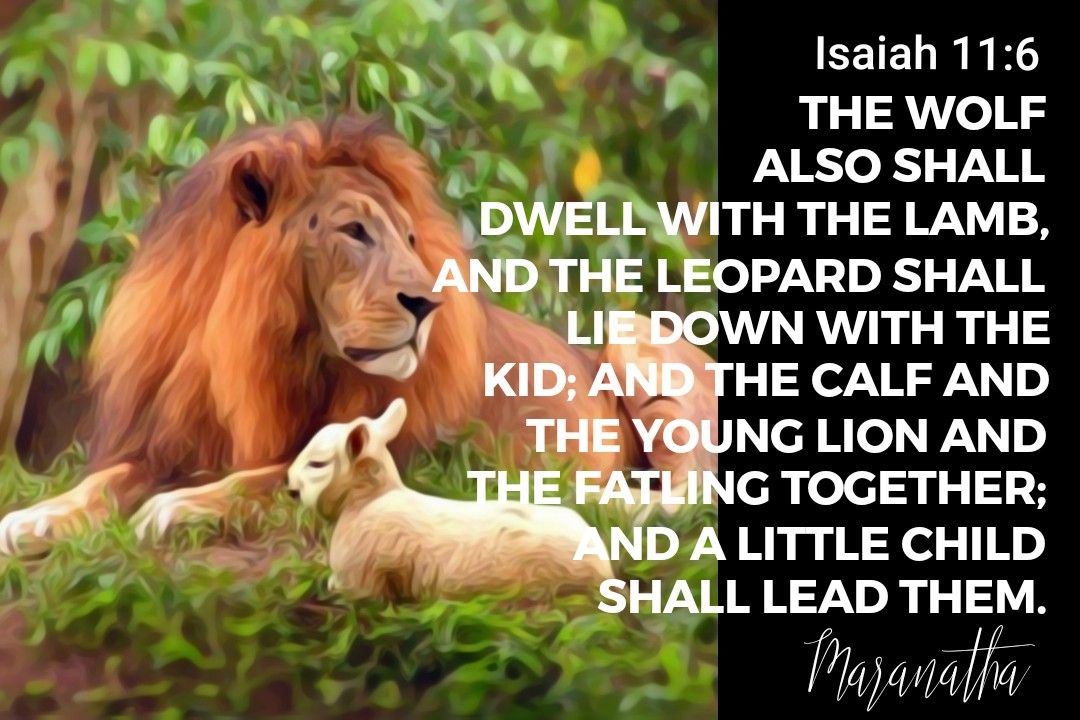







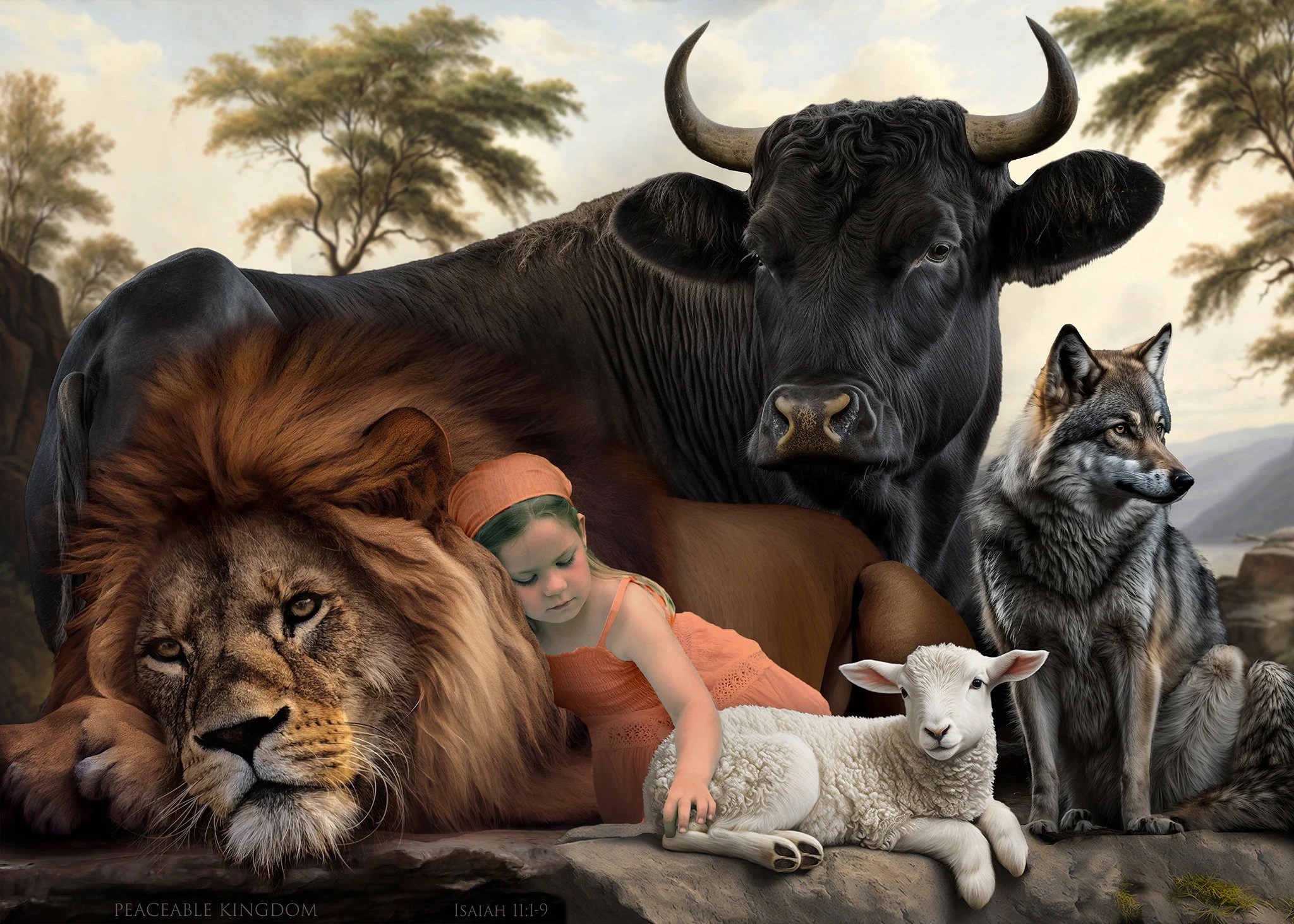
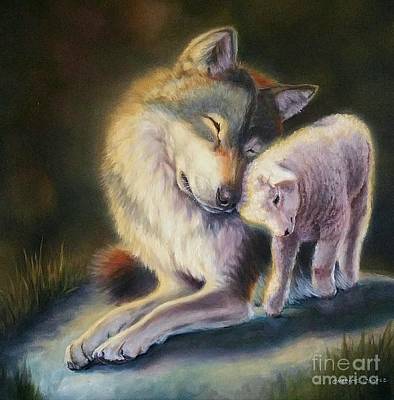

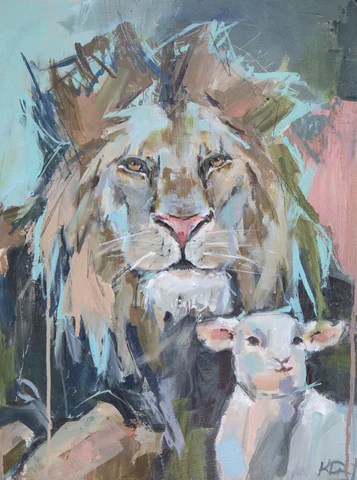


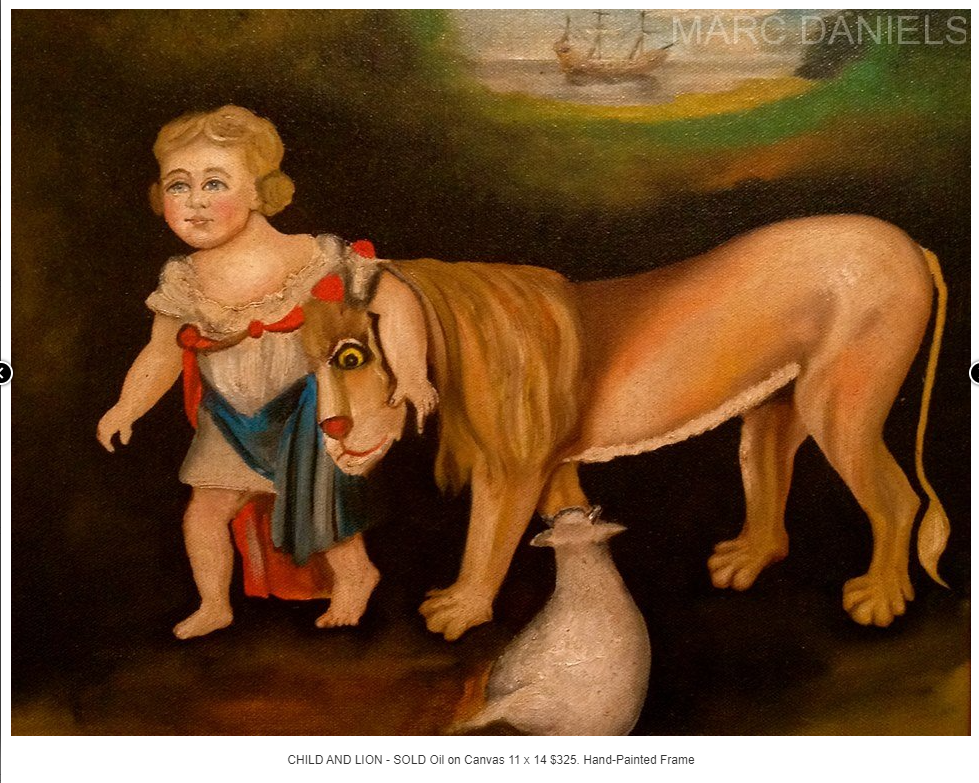

Bonus Material
For more information regarding Isaiah 11:6 and the art that it has inspired, please check out the following links:
- “The Peaceable Kingdom” by Edward Hicks (JOY OF MUSEUMS VIRTUAL TOURS)
- Tag: Isaiah 11 (Art & Theology)
- Where does the Bible say the lion will lie down with the lamb? – Isaiah 11:6 (Never Thirsty, Like the Master Ministries)
- What does the Bible mean by the expression the lion and lamb shall lay down together?! (Andrew Corbett)
- For more information on this famous painter and piece, check out Christies.com or Google it.
- To view other works of art by Hicks, visit his page on WikiArt. We have included other historical pieces below.
- We also found Names and Titles of the Lord Jesus Christ by Chales Spear (1841), a Universalist minister who wrote concerning Christ Jesus’ titles both of Lion and Lamb with reference to the lion with the calf and the falling, but not the lamb. (Check it out here on page 231/245.)
- “The lesson of Noah’s Ark is that wolves can lie down with lambs” (rabbisacks.org)


 Bible Version Conspiracy