
Beyond King James Version Onlyism
A Reflective Essay By Chase Dowell
My journey into KJV-onlyism began when I returned to Christ, like the prodigal son, after wondering from him in my childhood. I had left the Church not long after my confirmation and baptism, and spent many years “in the world” in every sense of the phrase. But in God’s providence and grace, my heart was stirred, and for the first time in my life I picked up a Bible and began to read.
I was so disconnected from Christianity as we entered into the digital age that I was not aware Bibles could be read for free on mobile apps. So, doing what any book lover does when a book is needed immediately, I opened my Kindle and purchased a New King James Version—having absolutely no idea what that meant. In my childlike understanding of Scripture, there was simply “the Bible” and I knew nothing of translation and variations within the biblical manuscripts that have survived history, a testament of the past and our ancient faith.
About halfway through Genesis, I realized the digital format was just not going to do. I wanted a physical Bible. The weight of God’s Word demanded a corresponding feeling in my hand. So I drove to a nearby store and bought the first physical copy I would ever read. Though I had been gifted Bibles growing up, they had long since disappeared—having never understood their value, something I would later come to regret. I picked one off the shelf that looked good: hand-sized, brown and tan cover. It happened to be an NIV.
Not long after, having read significant portions of the Pentateuch and the Gospels, the Spirit convicted me of my sin, drove me to my knees, and brought me to Christ. As I continued in Scripture and grew in my faith, I began attending a congregation—one where Textus Receptus preferences and KJVO leanings were present in some circles, though not officially held by the church.
One well-meaning lady pointed out that my Bible was missing verses. I had noticed the footnotes about manuscript variation all along, but it had never occurred to me that this was supposed to be concerning. I showed her the footnote containing the verse she said was missing and explained that my Bible wasn’t hiding anything.
I had no context for these new ideas I was being introduced to, and this issue came up again and again. Once, an elder in the church pulled a few Bibles off his shelf for me to compare verses in a passage in order to demonstrate some issue. I read them and considered what each said. I responded to him, confusedly, “They are saying the same thing.” I was perplexed. I couldn’t see what they saw and didn’t understand their fear and concern. I certainly hadn’t learned such anxieties from reading God’s Word.
I felt the need to defend my Bible. This was the Bible that introduced me to Jesus, the one I was reading when He became my friend, the one that brought me to tears at the Last Supper, the one in which He became my Lord and Saviour, and finally my King. But the idea that something was wrong with the text had been planted, and as these interactions continued, their suspicion would eventually become my own.
From my perspective, these ideas were coming from church leaders who had been walking with the Lord much longer than I had; perhaps they understood something I didn’t. Before long, I switched back to the NKJV. Still, for my own conscience, I needed to dig deeper. I had been pressed to adopt their concerns without, in my opinion, a satisfactory justification. Over the next year, as I neared the end of my first full read-through of Scripture, I began devouring textual debates and lectures on textual criticism and related topics. I must have watched hundreds of hours. I started leaning toward the Critical Text (The base text underlying most contemporary translations of the New Testament). The reasoning used to weigh manuscripts and decide between variant readings struck me as thoughtful and well grounded. This is when I started reading from the English Standard Version, influenced by Christian teachers I was watching online. I saw these men exposit the text with deep conviction, and I could see their love for God’s Word, something I shared, and I was drawn to it.
As it turned out, this leaning would only be temporary. Circumstances had placed me in a new church where their particular flavor of onlyism was even more pronounced. They used the KJV exclusively in preaching and teaching—something I had not yet experienced. To their credit, exclusive use of the KJV wasn’t treated as a condition of fellowship, nor was anyone required to use the KJV for personal devotion or study. Yet, that openness was never explicitly communicated to the congregation; it remained more of an unspoken liberty. Unfortunately, that silence created space for onlyism to take root and fester. This setting naturally inclined me to explore the KJVO position more seriously—not just the Textus Receptus or the traditional text and Majority/Critical Text positions, but the distinct claims of KJV-onlyism itself.
In conversations with my peers, I quickly realized we were approaching the issue from very different starting points. Whenever I brought these issues up, my closest friend in the church seemed disinterested. He told me God had told him the KJV was the correct Bible to use. From his perspective, there was no need to understand the nuances of textual issues or to weigh the arguments for one text over another—even when my presentation was in support of the King James. I have no doubt my brother genuinely believed God had told him the King James Bible was the correct one to use. In his mind, he was simply exercising obedience to Christ, and therefore any further examination was unnecessary.
God never gave me such a revelation, so for the sake of my own conscience I had to investigate these matters, assess all the positions for their strengths and weaknesses, and know the truth for myself. In the end, I became convinced of KJV-onlyism—or, more accurately, I became convinced that absolute certainty about the entirety of the text was necessary, and King James–onlyism was the only position that seemed to allow for it.
As providence would have it, a move to a new city, closer to family, brought me to yet another church—one where no one held to any kind of “only” position. The sermons were preached from the NIV, which unsettled me a little at first, but I still carried my King James to the pews each week. It gave me a sense of security, as though I could quietly measure everything I heard against what I believed was the true text and, as the saying goes, “eat the meat and spit out the bones.”
Around this time, my mother experienced her own return to Christ, and we were attending that church together. She asked me to help her find a Bible. By then I had become a collector of sorts and very knowledgeable about the offerings from all the major publishers, and though I had settled firmly into KJV-onlyism, I accumulated many editions across many translations along the way.
My mom had just one requirement: anything but the King James. We had discussed my preference before, but I felt strongly that I shouldn’t pressure her. In some ways, I felt I was better off before I started down this path to onlyism. And as I watched the Lord revealing her newly kindled faith, a question pressed on me more and more: What good had my onlyist position actually done for me? In the end, I simply helped her choose what suited her needs—a large-print thinline with a purple cover. I slipped a NKJV into the list of options, secretly hoping she might pick it, but she chose the NIV.
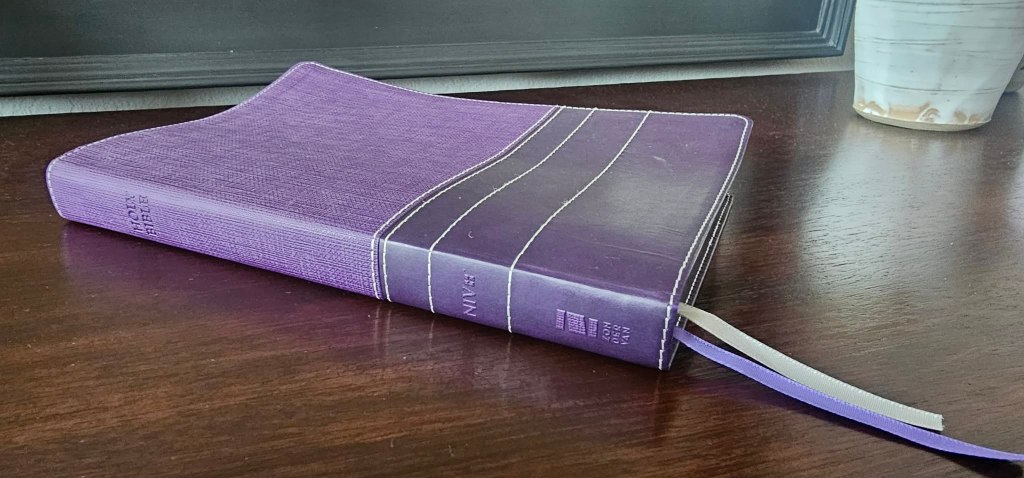
During that first year in the new church, we read through the Bible together and met weekly to discuss the readings. Over the course of that year, I saw the Lord working in my mother’s life in unmistakable ways, which only further softened my heart and kept that same question before me.
That church would only be a momentary stop on my way to what would become my church home. While going through this textual journey during the preceding six years, I was simultaneously going through a theological one.
When I began attending the church I now call home, I asked the pastor for recommended theological readings. He pointed me to Christian Doctrine by Shirley Guthrie. Guthrie’s Neo-Orthodox approach was completely foreign to me—especially his view of Scripture. While I wouldn’t embrace all his conclusions, his book did open my eyes to something that had been staring me in the face the whole time: there is a spiritual nature to Scripture that cannot be understood in physical terms. I had heard echoes of this idea before, ironically from those defending the King James Version as a kind of sacred textual standard for the English-speaking Church.
The Word of God is “living and active, sharper than any two-edged sword.” I had witnessed its living power in my own mother’s life and experienced it myself from those very first days of picking up God’s Word. And slowly, I began to grasp a deeper understanding of what I already knew: what transforms hearts is the Spirit of God speaking through His Word, and that work of grace is not hindered by some personal uncertainties in the text. For the ink that pools and spreads across the vellum, the strokes that draw the droplets into letters, the words that slowly take shape, are but a visible sign of the thing signified. They point to the greater reality than themselves that has no container we can see or fully understand.
When I look back on my journey into only-ism, I began to see parallels between my own heart on this matter and the very things Jesus so often rebuked in the Pharisees. Imagine driving up a mountain near dusk when a valley suddenly opens before you and a breathtaking sunset fills the horizon. You pull over and start fiddling with your camera and adjusting its settings, trying desperately to capture the perfect shot. But you spend so long seeking perfection in the image, that you miss the sunset entirely and the opportunity to enjoy the perfection of the reality that image was meant to point to, and the beauty God placed before you in that special moment.
I now understand that I cannot ultimately figure out the entirety of the text in its hundreds of thousands of words down to the single letter with absolute certainty. No one can. By God’s grace it’s clear to me we were never meant to. God, in His providence, did not give us a completed text of Scripture free from variation in any age—including the King James. This is something the informed onlyist must reckon with, and some do so with more or less consistency. Nor did He give us instructions for identifying a single copy as the standard, or for constructing one.
And maybe that’s the point. Maybe the human element so evident in the transmission of the text is intentional on God’s part—bringing His Word down to us in a form meet for us. A well preserved text with minor variation that points to the perfect Word. Perhaps the absolute perfection we long for in a text is really a misplaced longing for the absolute perfection found only in Christ, the living Word. And even if such flawless perfection could be captured in physical form in all its glory, would we be capable of beholding it unveiled? Or would we, like the Israelites, shrink back—pleading for God to speak through Moses instead—afraid of the radiance reflected in his shining face?
And with that realization—I began to see how Christ was the one feeding us, even when I thought I was the one sorting the meat from the bones. And after a seven-year journey that took me into KJV-onlyism along the way, and then out of it—my conscience came to rest. Today I have the freedom to read and be nourished by God’s Word in a variety of translations with textual variation between them, free from the anxieties of onlyism which can never deliver what it promises, utterly certain of Christ’s ability to spiritually feed my soul through His Word—which despite my ignorance is always meat, never bones.
To God be the glory!
Stepping away from a King James Version–only perspective was never just about favoring one translation over another. It was about recognizing that I had once put myself alone in the driver’s seat of discernment and had failed to see God’s care in feeding His children through His Word in all of Church history. In that independent frame of mind, I adopted a narrow view of Scripture and inspiration that made it difficult to see beyond a single text. But as I became exposed to—and began to embrace—the broader landscape of Christian theology and the rich tradition of the Church, I found my way out of that mindset.
It was this shift—from a solitary approach to a communal, historically grounded understanding—that allowed me to appreciate Scripture more fully and to recognize that we all need the wisdom of the Church, now and in history to guide us. And I believe this is the key to freeing the conscience of many bound to King James–onlyism: helping them understand a robust doctrine of the Word. Entangled within the KJVO mindset is a particularly narrow view of Scripture and inspiration that is incompatible with Church history, the extant manuscript evidence, and the way the Church has understood these matters for millennia. This wisdom must reach the onlyist, because apart from a miraculous work of God, I’m not sure anything else could release them.
From this I conclude that it is both good and right to desire the best possible text of Scripture and to labor faithfully to render it in every language under Heaven. Yet this work—and our understanding of it—must be kept in its proper proportion. Our certainty does not rest upon the absolute perfection of our labors, nor upon the possession of a flawless physical copy of God’s Word. Our certainty rests in Christ Himself. It is His work, not ours, to ensure that His Church hears the words it needs for faith and life.
And so this is my hope and my charge to the Church at large: that she would rediscover her roots, embrace the inheritance of the past, and receive with gratitude the blessings God has bestowed through the ministry of His Church in every age. And may the faithfulness of our Lord Jesus Christ sustain you until His appearing—and keep you unto everlasting life.
###
This article was written for Bible Version Conspiracy by our Co-conspirator and friend Chase Dowell. To find out more about the Bible Version Conspiracy, visit our website at bibleversionconspiracy.com, check out our YouTube channel, or email us at bibleversionconspiracy@gmail.com with specific questions about this or our other content. Join the Co-conspiracy and support what we do at https://buymeacoffee.com/josepharmstrong/membership.
 Bible Version Conspiracy