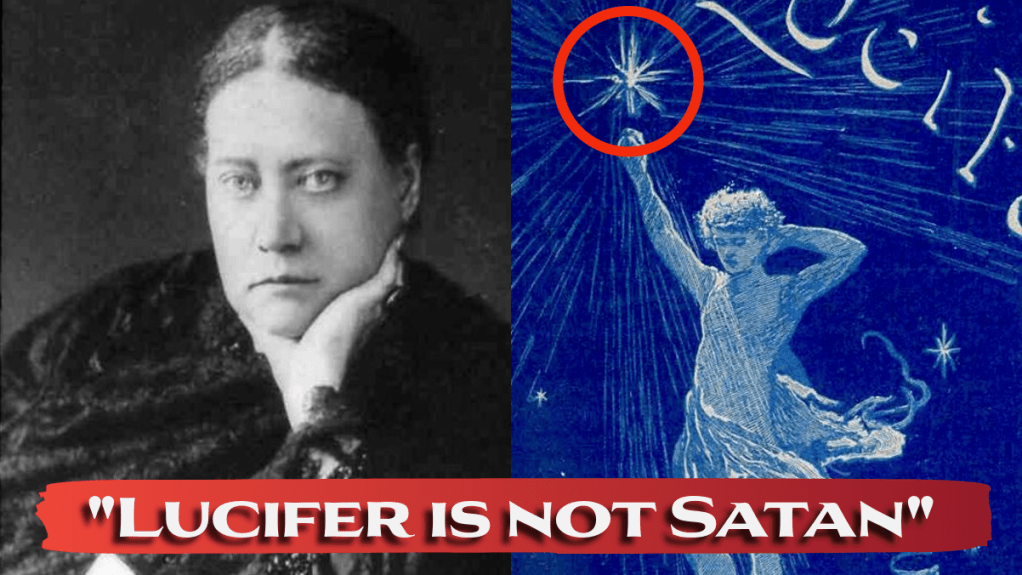
Did Helena Petrovna Blavatsky (1831-1891), the OG New Ager who founded the Theosophical Society and Lucifer Magazine, actually worship Satan as is so often accused? Does Isaiah 14 describe the fall of Satan from heaven? Are KJV-only apologists spreading falsehoods about Blavatsky, modern Bible translators and their translations, and even the word “Lucifer” itself? 🤔 Short answer: no, she didn’t, no, it doesn’t, and yes, they are! 😳
According to John Algeo (1930–2019), National President of the Theosophical Society in America, the first article that Blavatsky wrote for Lucifer Magazine confirms our own research into the “Lucifer” translation controversy from our formerly KJV-only perspective. Not only that, but Blavatsky taught the same thing about the name “Lucifer” in Isaiah 14:12 as the many faithful and learned Christian commentators and translators, which we’ve been exploring. In fact, it appears the one major difference between the insights of men like John Rogers, Matthew Poole, King James, the KJV translators themselves (!), Noah Webster, John Calvin, Adam Clarke, etc, and Blavatsky is that Blavatsky’s conclusion dismisses the existence of Satan altogether.
We are not endorsing Helena Blavatsky, John Algeo, or the Theosophical Society, nor are we defending their beliefs or teachings. I’ve read quite a bit of her book Isis Unveiled, Volume 2: The ‘Infallibility’ of Religion. We are well aware of what she thought of religion, especially Christianity, and history, and we have been clear on multiple occasions that she got a lot of things wrong and that, although her wisdom is extensive, it is not infinite and is dangerous if taken uncritically. We simply want to show that she has been wrongly accused of Satan worship, and did not teach that he is an impersonal force as some claim. Disingenuous authors have read her article “What’s in a Name?” and continue to lie about her beliefs to protect their anti-modern version rhetoric. This dishonesty is an unfruitful work that we are reproving. It also adds to our own exposure of the meaning and history of the word “lucifer”.
We also do not seek to prove an error in the KJV since, properly understood, it is saying the same thing as any other modern version in this case since “day-star”, “morning star”, “planet Venus”, and “Lucifer” are synonymous and accurate translations in the context of Isaiah 14:12. “Lucifer” is, however, the easiest translation to be misunderstood by modern readers because its classic sense has fallen almost completely out of use. As a result, “Luciferian” has been acquainted with “Satan worshipper” which simply isn’t the case.
Several KJV-only books, some of them written by friends of ours, have claimed Blavatsky was a worshipper of Satan because she was “Luciferian” and strongly imply that the translations of modern Bibles which read “Day-Star”, “Morning star”, etc., may be as well. This is not typical of KJV-only literature, but his standard fare in those written from a conspiratorial perspective. As conspiracy theories often go, these accusations are founded on half truths and misunderstandings. We hope this helps to set the record straight.
Mr Algeo’s article is reproduced below in bold. My comments are in [[ double brackets ]].

John Algeo writes:
“How Lucifer got to be used as a name for a devil is a complicated story. In the Book of the Prophet Isaiah (chapter 14), there is a passage talking about the King of Babylon, who was not a favorite of Isaiah’s. Verse 12 of that chapter runs (in the oldest known version of the Bible): “How you are [sic] fallen from heaven, O day-star, son of the morning! How you have been cut down to the ground-you who laid low the nation” (Dead Sea Scrolls Bible 292).
“The King of Babylon had apparently been given (or perhaps himself assumed) the title “Day-Star,” which is a name for the planet Venus, the first planet or star seen in the morning just before the sun rises, hence the King was also called “son of the morning.” The identification of important monarchs with heavenly bodies has always been common, as for example King Louis XIV of France was called the “Sun King.” Now, the word Lucifer “light bearer” was the Latin term for the “day-star” or Morning Star because it brought in (or bore) the light of the day.
“So when the Hebrew scriptures were translated into Latin, the word lucifer was used in this verse, rendered into Latin as Quomodo cecidistide cælo, lucifer, qui mane oriebaris? That is literally, “How have you fallen from heaven, light bearer, who are born in the morning?” The reference to falling from heaven was doubtless Isaiah’s way of putting the Babylonian king in his place by sarcastically observing in effect: “OK, you call yourself the Day Star of Heaven, you who think you’re so high and mighty, but look at you now–you, the so-called Day Star, have fallen from your place in the heavens and have yourself been cut down to the ground.
[[ Please note this is exactly the same interpretation offered by many godly and learned Christians who have put aside Roman Catholic traditions when they conflict with or obscure the plain meaning of Scripture. This can be clearly seen, for example, in the notes of both Matthew’s Bible and Geneva Bible³, as we have discussed elsewhere.
Unfortunately, some fundamentalist researchers pretend that the fall of Satan scenario is the only interpretation acknowledged by genuine Christians who have not fallen into blasphemous error. One young KJV-only blogger (speaking from a place of pure innocence and good intention), goes so far as to say that no one questioned the Isaiah 14:12 fall of Satan narrative until Westcott and Hort! Elsewhere we have discussed why they see any translation other than “Lucifer” as blasphemous, so we won’t get into that now. These authors have set up a scenario or a modern translators are following occult beliefs in their translations. This is not the case, and it’s easy to show when the facts are considered. The false accusations need to be exposed, and showing whay Blavatsky actually believed and taught is a great way to do it.
The fall of Satan is indeed an ancient tradition, but this in this tradition Satan is being compared with the planet Venus, as Algeo goes on to discuss. ]]
“However, the early Christian interpreters misunderstood the expression “fallen from heaven” and, instead of recognizing it as a figure of speech playing on the destruction of the wicked King of Babylon, who called himself the Day Star, they thought it was a literal statement about a fall from heaven and identified the event with the legendary fall of Satan. So they thought that the term “Day Star,” or “Lucifer” in Latin, referred to Satan. And thus a term for the planet Venus became one of the names of a devil. It was a mistake caused by misunderstanding figurative language as a literal statement, a common problem among fundamentalists.
[[ The “figurative language” being confused for literal is the taunt from the dead kings that the king of Babylon had “fallen from heaven”. They compare his death to the planet/star Venus falling from the sky. Here “heaven” refers to the sky, not the abode of God and the angels. Reading the KJV, we assume we know the meaning of these “false friends” (“heaven” and “Lucifer”) which are used in an unusual, more archaic sense than we typically understand them. This is made especially clear regarding “Lucifer” in the KJV’s own marginal note which reads “Or, O Day-starre”. Since we commonly refer to the big blue thing above us as the sky, rather than heaven, it is easy to see how confused interpretations of this passage have been reinforced by the passage of time. KJV-only fundamentalists fight against modern translations, complaining that modern versions omit “heaven” many times when they, in fact, simply make a distinction by using “sky” and “heaven” according to the context.¹
Unfortunately, the same KJV-only people (and even some commentators) see the fall of Satan as essential to the understanding of Isaiah 14 because the king of Babylon didn’t fall from heaven. To them, Satan is the only being that fits the bill. Some pretend that only New Agers and occultists take the view Mr. Algeo expresses while carefully avoiding the fact that many sound Christian commentators and translators through the ages taught the same truths as presented by Mr. Algeo. Thanks to the suspicions and panic spread by these careless authors, insinuations and accusations of closeted satanism fly freely against, not only Blavatsky, but anyone and anything not in accordance with narrow KJV-only views. ]]
“The story does not end there, however, at least not for Theosophists. When Helena Blavatsky moved to London in 1887, she decided to start a new magazine, and she chose to name it Lucifer, against the advice of some of her friends.² The choice of that name was surely due, at least in part, to Blavatsky’s wicked sense of humor. She knew very well that the literal-minded and unimaginative of her day would associate the name with the devil. She was saying in effect: Very well, you think I’m a devil well, here’s another little tidbit for you to chew on. That is, she used the name to tweak the noses of the literalists.
[[ We don’t quite agree with Mr. Algeo that the fall of Satan (the traditional interpretation of Isaiah 14:12) is the literal interpretation of the passage. However, we do see how he could think it’s literalistic since it’s how it is taken by most Christians who only consider the passage at face value and only in the light of strong cultural traditions.
Although Blavatsky was involved in occultism and the New Age, continuing to pretend Blavatsky worshiped Satan is not only irresponsible, but it is also downright dishonest and false accusations do not come from the heart of Christ. We all remember who the Father of Lies is, don’t we? ]]
“The very first article in the first issue of the magazine was ‘What’s in a Name?’ and was by Blavatsky herself. In it, she explained what the name really means and how it came to be misunderstood and misapplied. She also explained why it was the right name for her magazine, which was intended (as St. Paul says in 1 Cor. 4.5) to bring “to light the hidden things of darkness.” She wrote that the purpose of her new magazine was “to fight prejudice, hypocrisy and shams in every nation, in every class of Society [sic], as in every department of life.” To top it off, the illustration on the cover of the magazine depicted a brilliant youth holding aloft a blazing star that he is bringing to earth.
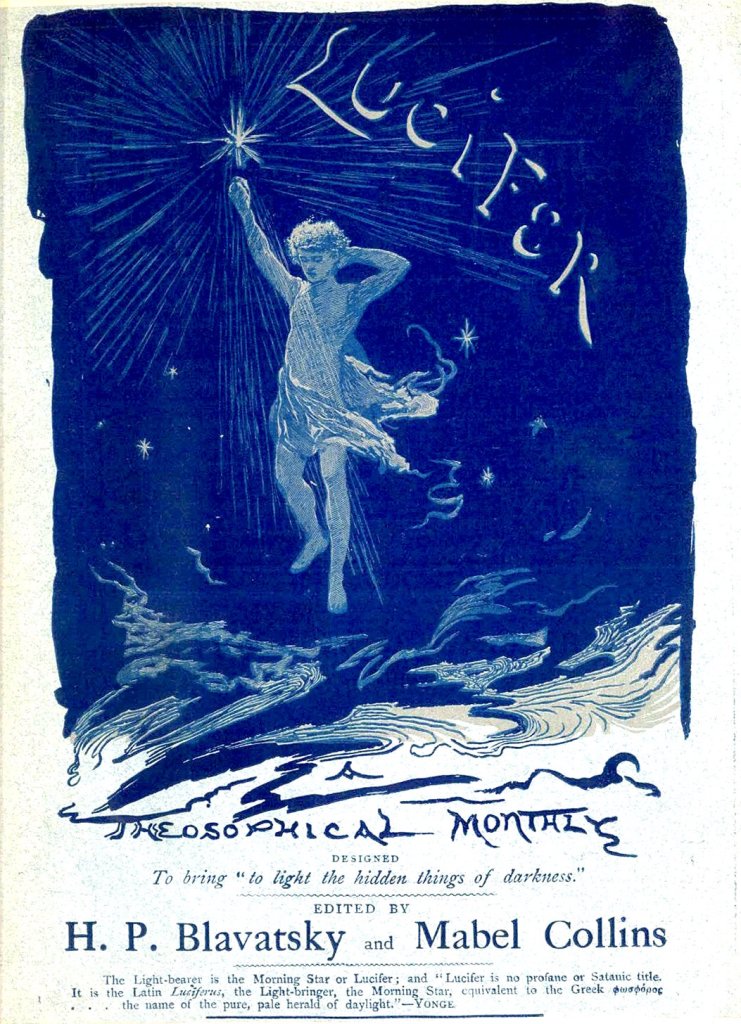
“Blavatsky furthermore pointed out that in the Book of Revelation, Christ referred to himself as “the bright and morning star,” that is, Lucifer. And the Gospel of St. John (1.4) says, “In him . . . was the light of men.” Blavatsky identified Christ with Prometheus, who brought fire and thus light to humanity and who was thus etymologically a Lucifer or Light-bearer. Christ, Prometheus,and Lucifer were all symbolic bringers of light to the world and consequently savior figures.
[[ Close followers of the Bible Version Conspiracy know who we’re talking about when we say certain authors and their followers criticize the Latin Vulgate for saying “lucifer rising” in 2 Peter 1:19 refering to Jesus Christ. Not only do these researchers not understand — or at least are not willing to publicly acknowledge and discuss — that “lucifer” is simply the Latin name for the planet Venus or daystar, but these same individuals loudly praise the Old Latin Bible and cover up the fact that the Old Latin reads exactly the same as the Vulgate! Is this due to a massive conspiracy? No. It’s simply because they are both written in Latin.
The Google AI summary informs us of other passages where the word “lucifer” is used in the Latin Vulgate:
“Job 11:17: Referring to a man arising like the morning star.
Job 38:32: Asking if one can bring forth the morning star.
Isaiah 14:12: Addressing the King of Babylon as “Lucifer,” who rose in the morning and fell from heaven.
2 Peter 1:19: Referring to the “day star” (lucifer) arising in hearts, which in this contextt refers to Jesus Christ.” ]]
“Blavatsky certainly did not believe in the existence of any literal devil, under whatever name. And she doubtless thought that ideas about the devil were a mixture of legends and misunderstandings of metaphorical and symbolic language, of which the name Lucifer is a prime example. For that reason also, it was a good name for her magazine.” — Viewpoint: Lucifer: What’s in a Name by John Algeo (2001).
Translation differences between modern Bible versions and the KJV have been blown far out of proportion by KJV-only fundamentalists in recent decades. Thankfully, most Christians are willing to absorb information that does not contradict clear scriptural teaching, whereas the fundamentalist mentality all too often keeps itself from asking serious questions and protects itself from the truth out of fear. The Isaiah 14:12 controversy illustrates how, when mixed together, tradition, ignorance, presumption, superstition, and paranoia can form an especially corrosive compound. Sadly, drinking this conspiratorial cocktail often brings out the worst in the “Onlyists” and accusations and suspicions of satanism fly freely against any man or woman who dares to question the voices of their movement. Men or women in our own century or in the 19th century.
Read John Algeo’s full article at https://www.theosophical.org/publications/quest-magazine/viewpoint-lucifer-whats-in-a-name
As we wrap up 2025, a new year dawns with plans to explore the “Lucifer” controversy more deeply, finally finish and publish our official Lucifer page, the article Blavatsky wrote about “Lucifer” for the first edition of her magazine, write an article exposing the usage of “lucifer” in Latin manuscripts, finish our page about Gail Riplinger’s nutty and dishonest Shepherd of Hermas and Epistle of Barnabas claims, and lots of other fascinating topics. We will also begin work on the chapter we’re contributing to the upcoming book, The Myth of “New Age Bible Versions”. Stay tuned and subscribe so you don’t miss anything!
Question of the day: Have you ever been accused of something that was exactly the opposite of the truth? How did it make you feel? Has that experience made you more careful to hear both sides of the story before passing judgment?
▶️ Check out our other articles on the “Lucifer” controversy and KJV-onlyism at https://buymeacoffee.com/josepharmstrong/posts/203638
▶️ Subscribe to our exposure of the conspiracy behind the Bible version controversy on YouTube: https://youtube.com/c/bibleversionconspiracy/?sub_confirmation=1
▶️ Join the Co-Conspiracy to follow our exposure of the conspiracy behind the Bible version controversy on a deeper level and support what we do: https://buymeacoffee.com/josepharmstrong/membership
Notes
¹ The KJV only uses “sky” seven times and “skies” 5 times compared to the NKJV’s “sky” nine / “skies” seven, and NIV’s “sky” in eighty-four verses / “skies” 16 verses. The NKJV retains both “heaven” and “Lucifer” in Isaiah 14:12, whereas most translations replace “Lucifer” with “morning star”, “day-star”, “shining one”, etc. Several versions use “heavens” in this context as Algeo did in his paraphrase to refer to the sky/outer space, but it seems only the NET replaces “heaven” with “sky” in Isaiah 14:12.
² The friends won out eventually as the Magazine was renamed the Theosophical Review ten years later.
³Matthew’s Bible (1537) “How art thou fallen from heaven O Lucifer thou faire morning childe? hast thou gotten a fall eve to the grounde / thou and (not witstanding) didest subddue the people? Marginal note, “He compareth the death of Nebuchadnezzar to the falling of Lucifer the morning star which he calleth the child of the morning because it appeareth only in the morning. The meaning is: no such thing ought to have happened unto thee, that in earth was like the morning star, which no man can take out of heaven: And thou that wast so mighty that thou destroyedst what people thou wouldest and unto whom it was a pastime to overthrow nations, hast received such measure as thou broughtest. Such a like thing is there in Ezek. 28. Against king Cyrus.”
Geneva Bible margin note (1560) “How art thou fallen from heaven, O Lucifer, son of the morning? and cut down to the ground, which didst cast lots upon the nations?” Marginal note: “Thou that thought thyself most glorious, and as it were, placed in the heaven for the morning star, that goes before the sun, is called lucifer to whom Nebuchadnezzar is compared.”
This content (minus a few editorial changes) was originally published to our Buy Me A Coffee page on December 31, 2025 under the title “Did Luciferian Madame Blavatsky Actually Worship Satan? 🤔😈”. https://buymeacoffee.com/josepharmstrong/did-luciferian-madame-blavatsky-worship-satan

 Bible Version Conspiracy