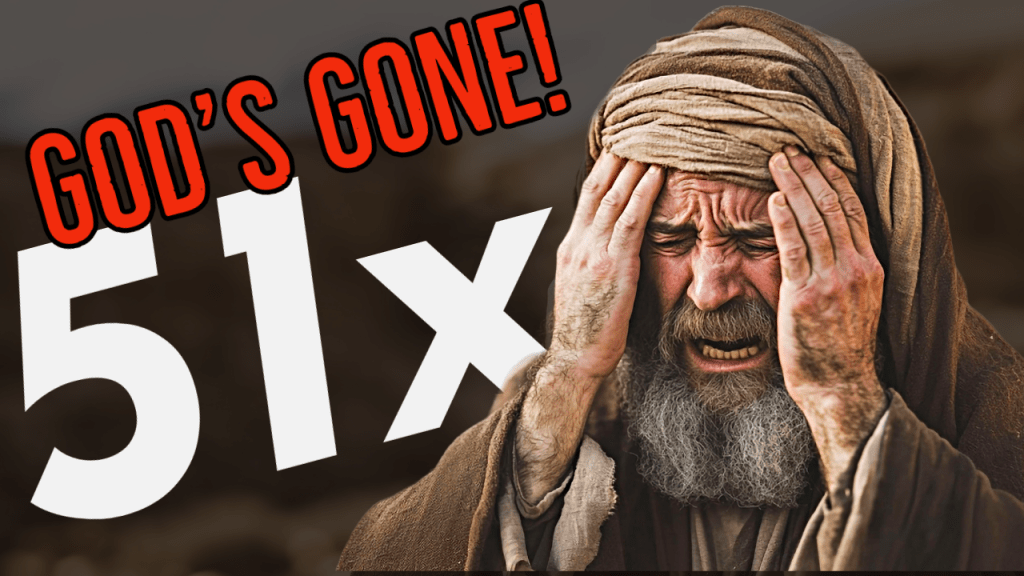
It’s true! The word “God” is in the New King James Version 51 FEWER times than in the KJV! 😵 This is proof of a conspiracy to eventually remove the Judeo-Christian God from the Bible and replace Him with a New Age “God of forces”! …or is it?
Sounds a little crazy, I know, but that seemingly off-the-wall belief is nothing new. It’s exactly what I used to believe and what thousands of others for the last 30 years have continued to believe thanks to one person. In her track called the NKJV Death Certificate, Gail Riplinger (author of the unhinged 1993 book New Age Bible Versions) presents the following chart.
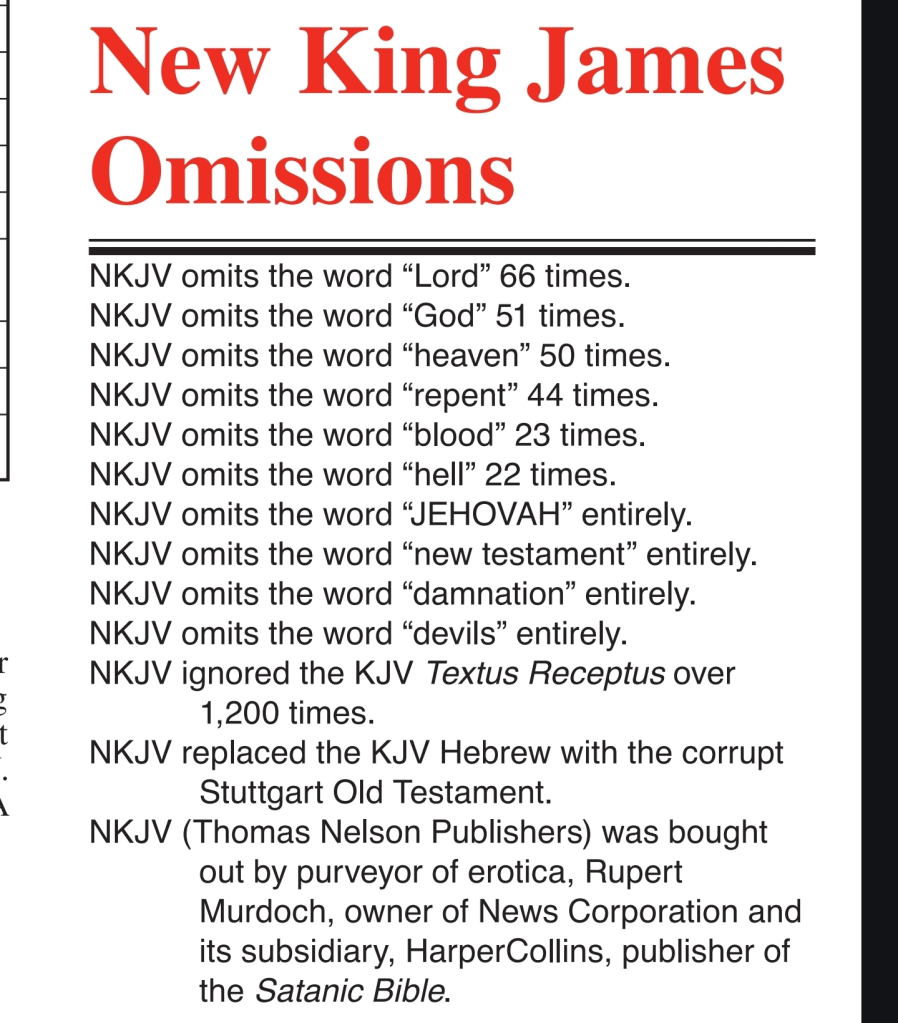
Modern versions are constantly leaving out words relating to God and Satan, aren’t they? That’s what Gail says. In her many presentations, Gail compared this series of “omissions” to removing the main characters of a novel. But is this actually a fair comparison? Are these indications of an Antichrist conspiracy, or is there more going on here that we are not being told? 🤔 Let’s take the second “ommission” in her list, “God”, as an example.
Rick Norris, author of The Unbound Scriptures, Discerning the Truth about the KJV, and a top contributor to our Facebook group Rebooting Gail Riplinger made a facinating comment on one of our group’s posts. The post was a video which responded to Gail’s oft-repeated claim of “God” being omitted from the NKJV 51 times as well as others on the chart. Rick writes:
“Gail Riplinger claimed in her tract [NKJV Death Certificate] that the “NKJV omits the word ‘God’ 51 times” (Church Bus News, April-June, 1996, p. 26). This inaccurate claim seems to be based on a simple comparison of the NKJV to the KJV and not on a comparison to the preserved Scriptures in the original languages. This count likely does not even take into consideration the places where the KJV has the word “God” added in italics. In the 2021 updated edition of New Age Bible Versions, Gail Riplinger continued to repeat her misleading, incorrect claim that the NKJV omits “God 51 times” (p. 4).
“In response to this misleading charge, James D. Price noted: “The truth is that the KJV added the word “God” in fifty one or more places where the Hebrew or Greek text did not contain it–and that without using italics in most cases. This was because the KJV used dynamic equivalence paraphrases such as “God forbid,” “God save the king,” or “God speed” instead of a more literal expression in good English. In all these places the NKJV made the KJV more literal and more faithful to the Hebrew and Greek texts without undermining the place of God in the Bible” (False Witness of G. A. Riplinger’s Death Certificate for the New King James Version, p. 4).
“James D. Price then discussed these times and demonstrated the faithfulness of the NKJV to the Hebrew and Greek texts underlying the KJV.
“Jack Lewis maintained that “the phrases ‘God forbid’ (1 Sam. 14:45; etc.) and ‘would God’ (Num. 11:29) add the word ‘God’ to the text” (English Bible, p. 44). Harold Rawlings claimed that “the KJV is replete with dynamic idioms like ‘God forbid’ and ‘God save the king’ that have no exact verbal equivalent in the original” (Trial by Fire, p. 192). In the introduction to his 1833 revision of the KJV, Noah Webster noted that the phrase God forbid was used several times in the KJV “without any authority from the original languages for the name of God” (p. ix). The KJV has “God forbid” eight times in the Old Testament and fifteen times in the New Testament. Michael Sproul maintained that “’God forbid’ is a dynamic equivalent of a Greek idiom in the English language” (God’s Word Preserved, p. 346). D. A. Waite acknowledged that the Greek for the KJV’s “God forbid” would be literally translated as “may it not be” (Foes, p. 96). KJV-only author David Cloud described this example as “’a little something like’ that which is called dynamic equivalency today” (Bible Version Question/Answer, p. 157). KJV-only author William Grady asserted that “occasionally” the KJV translators “even had the ‘audacity’ to insert an English idiom, with no manuscript authority whatsoever, such as the phrase ‘God forbid’” (Given by Inspiration, p. 44). David Daniell indicated that Luther’s German Bible has “das sey ferne (be that far away)“ instead of “God forbid” (William Tyndale, p. 142).
“At Acts 10:14, Tyndale’s and Matthew’s Bibles have “God forbid” while the KJV has “Not so.” At Acts 11:8, Tyndale’s, Matthew’s, Whittingham’s, and Geneva Bibles have “God forbid” while the KJV again has “Not so.” At 2 Samuel 20:20, the Geneva and Bishops’ Bibles have “God forbid” twice while the KJV has “Far be it” twice. This verse has the same Hebrew word twice that the KJV rendered “God forbid” several other times. At 1 Samuel 20:9, the 1560 Geneva’s rendering [“God keep it from thee”] and the Bishops’ rendering [“God keep that from thee”] were revised in the KJV [“Far be it from thee”]. Would Riplinger and other KJV-only advocates claim that the KJV omitted the name of God from the English Bible at these verses as they inconsistently allege against the NKJV concerning other verses?
“Were the KJV translators always completely faithful to their underlying original-language texts and always consistent in following the renderings of the earlier English Bibles? Instead of keeping the rendering of the earlier English Bibles, the KJV translators corrected the addition of the word “God” in several of them at 1 Kings 1:31. At Nehemiah 2:3, Coverdale’s and Matthew’s Bibles have a rendering with the name of God [“God save the king’s life for ever”] and the Geneva and Bishops’ Bibles have a similar rendering [“God save the king for ever”]. The KJV does not add the name of God at this verse [“let the king live for ever”]. At Daniel 2:4, Coverdale’s, Matthew’s, and Bishops’ Bibles have the name of “God” [“O king, God save thy life for ever”] where the Geneva and KJV does not. Coverdale’s and Matthew’s also have a similar rendering at the following verses (Dan. 3:9, 5:10, 6:6, 6:21).”
Pastor Scott Ingram also has an excellent video breaking down the details behind Gail’s chart.
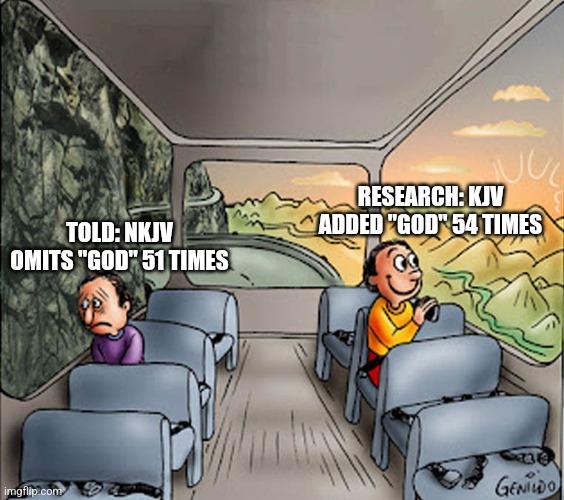
Gail Riplinger claimed that the NKJV removes the word “God” 51 times. The truth is the King James Bible “added” the word “God” to the text 54 times and there is nothing wrong with that. I hope it is clearer that this article has in no way been critical of the King James Bible. We can still say with confidence that there is not one error in the KJV’s translation of God’s word.
Sadly, we have come to grips with the fact that Gail’s so-called “explosive” exposes rely on shock value rather than documentation and understanding. Presenting only enough of the facts to be shocking but nowhere near enough to inform the reader about what is actually going on seems to be her standard mode of operation. We hope that more of her followers will take the challenge to evaluate Gail’s “documentation” and see the truth for themselves.
Some links are affiliate links and we earn a small commission from qualifying purchases. You can also view, search, and download New Age Bible Versions 2010 edition for free on the Internet Archive.
God bless!
Joseph Armstrong
bibleversionconspiracy.com
This content was originally published to our Buy Me A Coffee page on March 6, 2025. https://buymeacoffee.com/josepharmstrong/the-nkjv-omits-god-51-times
 Bible Version Conspiracy